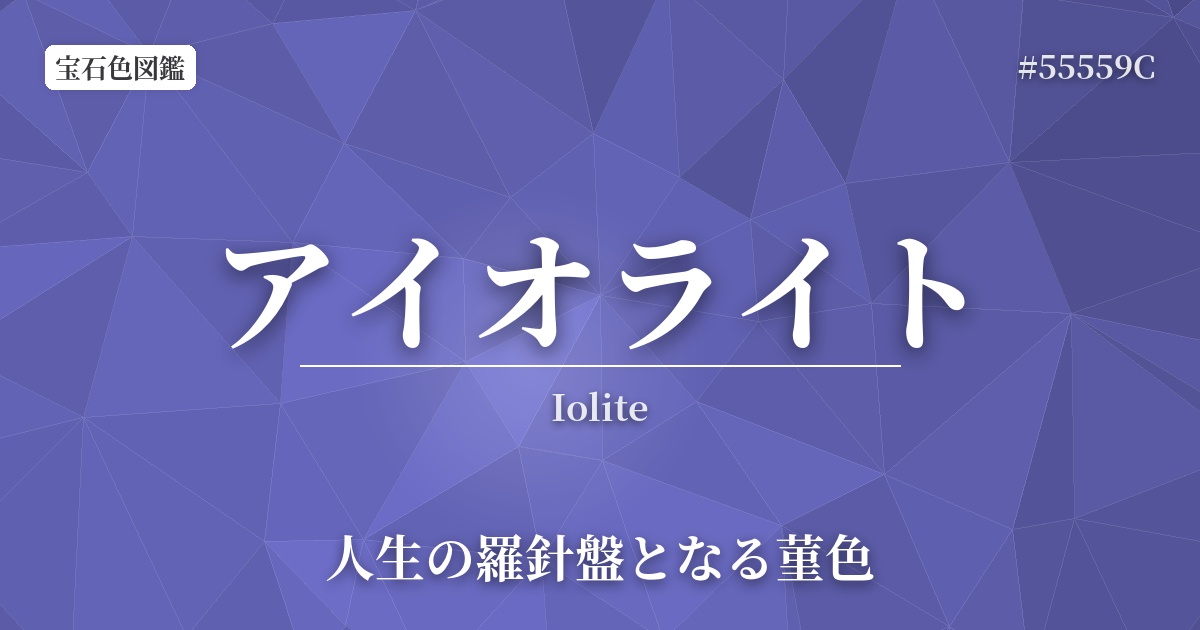
| English name | Iolite |
|---|---|
| Katakana | Iolite |
| HEX | #55559C |
| RGB | 85, 85, 156 |
| Mineralogy | Silicate minerals |
What is iolite? Origin and mineralogy
The name iolite comes from the Greek words "ios," meaning violet, and "lithos," meaning stone. As the name suggests, it is a gemstone with a beautiful violet color.
As a mineral, it is called "cordierite," named after the French geologist Louis Cordier. It is a type of silicate mineral with a Mohs hardness of 7 to 7.5, making it hard enough to be used in jewelry.
The most distinctive feature of iolite is its "pleochroism," which means its color changes depending on the viewing angle. Within a single stone, you can simultaneously see multiple colors, such as deep blue-violet, purplish-blue, and pale yellow or gray. Because of this property, it is also known as "dichroite" (two-colored stone).
It is mainly mined in various parts of the world, including India, Sri Lanka, Myanmar, Madagascar, Brazil, and Tanzania.
The history and culture of iolite
The most famous anecdote in iolite's history is its connection to the Vikings. It is said that even in cloudy or foggy skies where the sun was invisible, they would hold iolite up like a polarizing filter to find the brightest part of the sky, determine the sun's exact position, and use it to aid in their navigation. Because of this, iolite came to be known by the romantic nickname "the Viking compass."
This legend is not merely a story; it is considered scientifically sound because the strong polarization properties of iolite allow us to interpret the patterns of sunlight scattering by particles in the atmosphere. Iolite may have been a stone that pointed the way to a beacon of hope for people to embark on journeys to worlds yet unseen.
Iolite and Color Psychology
Iolite's deep, calming violet color is said to enhance insight and intuition, and to have a soothing effect on the mind. It is a color that supports you in discerning the essence of things and making calm judgments. In today's information-overloaded and often confusing world, it is a suitable color to turn to when you want to clear your thoughts and improve your concentration.
As symbolized by its gemstone keyword, "compass of life," iolite has long been considered a talisman that shows the way forward and guides one toward achieving their goals. Also known as the "stone of vision," it is believed to help those who wish to move forward in their own way toward their dreams and goals to listen to their inner voice and rediscover their true selves.
Color scheme preview
This is to check the readability of the text when this color is used as the background.
Iolite color scheme proposal
Silver (#C0C0C0)
The mystical violet hue of iolite combined with the sophisticated shine of silver creates an intelligent and modern impression. The two colors complement each other, resulting in an elegant and calm atmosphere.
Cornsilk (#FFF8DC)
The cool tones of iolite, combined with the gentle, warm cream color of corn silk, create a friendly and soft impression. The contrast is beautiful, resulting in a reassuring color scheme.
Sage Green (#B2AC88)
The deep violet of iolite and the gentle, natural hues of sage green combine to create a calming earth tone. It exudes a quiet, thoughtful, natural, and sophisticated atmosphere.
Practical Scenes
In the world of jewelry, iolite is cut in a way that maximizes its pleochroism. Its subdued colors are loved by people of all genders, and it is used in a variety of items such as rings, necklaces, and earrings. Because it has a similar hue to sapphire, it is sometimes used as a substitute, but iolite's unique pleochroism is its one-of-a-kind charm.
In fashion, it pairs exceptionally well with basic colors such as navy, gray, and white. Incorporating it as an accent in your outfit will create an intelligent and sophisticated style.
In interior design, incorporating this color through cushion covers or art panels brings tranquility and depth to a space. It's especially recommended for places where you want to calm your mind and concentrate, such as a study or bedroom.