
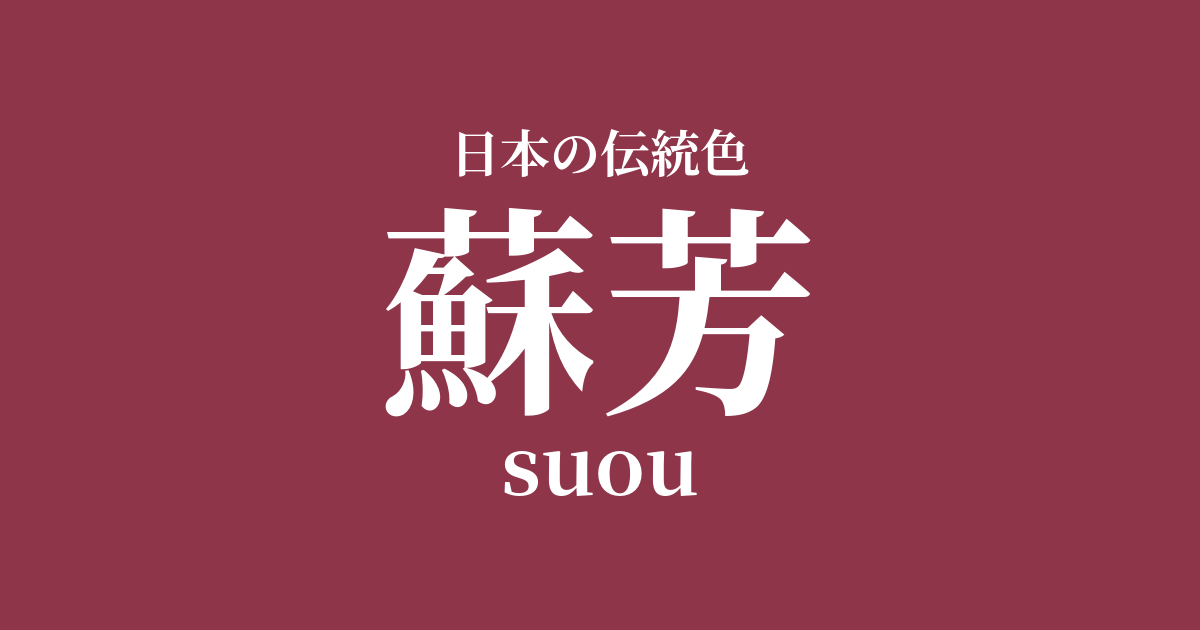
| Japanese color name | Suou |
|---|---|
| reading | suou |
| HEX | #8E354A |
| RGB | 142, 53, 74 |
What is Suou? Origin and etymology
Suou is a dark reddish-purple color produced by dyeing with the heartwood of the sappanwood plant, a tropical legume native to India and the Malay Peninsula. The heartwood of this plant contains a red pigment called brazilin, and by adding a mordant to a dye solution made by boiling it, a variety of shades can be produced, from reddish-purple to almost black red. The color changes depending on the type of mordant used; lye mordant produces a reddish-purple color, while iron mordant produces a dark purple color.
The name "Suou" is believed to originate from the Malay word "sapang," which is one of the places of origin. It is thought that this word was transliterated during its transmission to Japan via China, and that the kanji characters "蘇芳" were then assigned to it. It has long been a valuable imported product, and the name itself speaks to its exotic sound and rarity.
Historical background of Suou
It is said that sappanwood dye was brought to Japan by Japanese envoys to Tang China during the Nara period. Textiles dyed with sappanwood still exist among the treasures of the Shōsōin, indicating that it was already considered a valuable dye at that time. At the time, it was an extremely expensive import, and its use was limited to a select few privileged classes.
During the Heian period, sappanwood was considered a noble color, alongside purple and crimson, and was used in the clothing of emperors and aristocrats. The Engishiki, a collection of laws, also records that sappanwood was treated as a color equivalent to a forbidden color, indicating its high status. From the Kamakura period onward, it spread to the samurai class and was used in things like the lacing threads of armor. In the Edo period, it became popular among commoners as well, but the deep red color remained popular.
Related literature, waka poetry, and seasonal words
In Heian period literature, sappanwood (suzō) is frequently depicted as a color symbolizing a character's social status, education, or even their emotions. In "The Tale of Genji," it appears as the color of clothing in various scenes, adding a colorful depth to the story. Particularly famous is the scene in the "Suetsumuhana" chapter where Hikaru Genji mentally describes the princess with the red nose as having a "sappanwood nose." This is known as a symbolic description indicating that sappanwood is a reddish color.
Furthermore, in "The Pillow Book," the section on "things that are dreadful" mentions sappanwood-colored textiles, demonstrating how familiar and important the color sappanwood was in the aristocratic society of the time. Through these literary works, it can be seen that sappanwood was recognized not merely as a color name, but as a special color with a cultural background.
Color scheme preview
This is to check the readability of the text when this color is used as the background.
Suou's color scheme proposal
Blue gold (#FABE00)
The deep reddish-purple of sappanwood and the vibrant yellow of turmeric complement each other beautifully. This color combination gives a noble and elegant impression, creating a classic and refined atmosphere reminiscent of the attire of Heian period aristocrats.
Indigo (#274A78)
The deep reddish-purple of madder red and the calm blue of indigo are both deep colors that harmonize well. This color scheme conveys a sense of gravitas and intelligence, making it suitable for formal occasions or when expressing masculine strength.
White training (#FFFFFF)
When combined with pure white, the depth and luster of the sappanwood color stand out. The contrast becomes clear, giving a sophisticated and modern impression. This color scheme is suitable for designs that want to balance cleanliness and elegance.
Practical Scenes
In the world of kimono, sappanwood (safflower) is used in formal kimonos, obi sashes, and obi ties, and is highly valued as a color that conveys both a sense of calm and elegance. It particularly adds depth and a sense of the season to autumn and winter attire. It also pairs well with classic patterns, creating a dignified atmosphere.
In interior design, incorporating accent walls, cushions, curtains, and other fabrics brings a sense of weight and luxury to a space. Combining it with wooden furniture and gold-colored accessories creates an even more classical and sophisticated atmosphere.
In web and graphic design, using it as a main color can strongly convey a sense of luxury and tradition. Furthermore, using it as an accent color can tighten the overall design and draw attention. It is particularly well-suited to themes related to history and culture.