
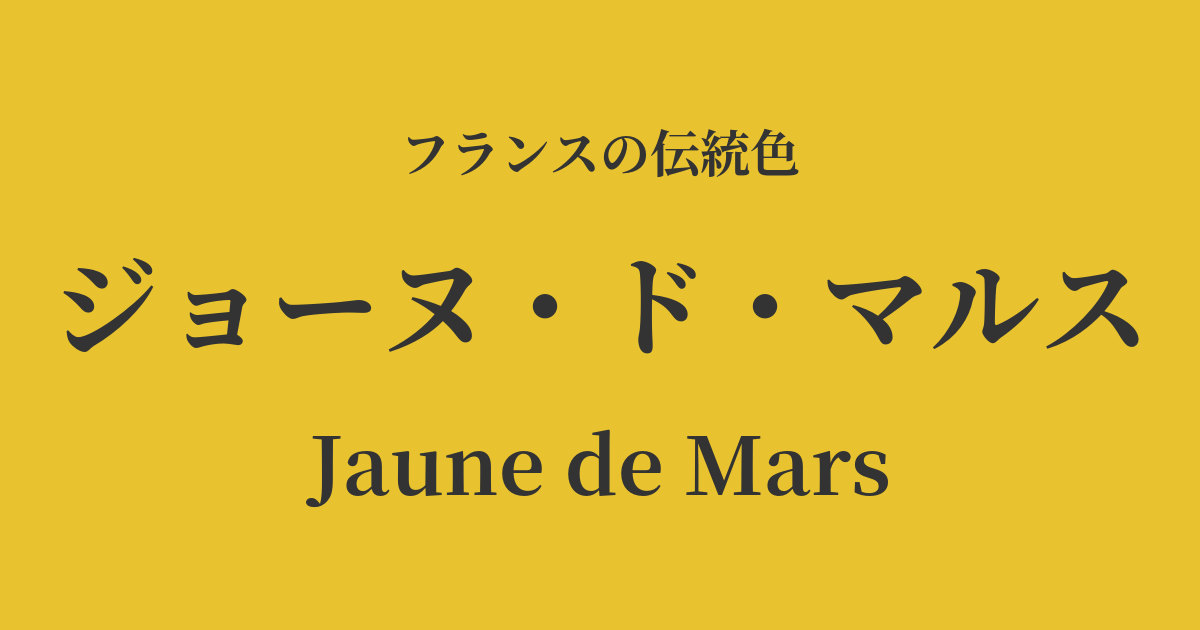
| French | Jaune de Mars |
|---|---|
| Katakana | Jaune de Mars |
| HEX | #e8c32f |
| RGB | 232, 195, 47 |
What is Jaune de Mars? Origin and etymology
"Jaune de Mars" is a French name for a warm, vibrant yellow color, meaning "Mars yellow."
The name originates from Mars, the Roman god of war. In the world of alchemy and astrology from ancient times to the Middle Ages, it was believed that the seven planets and seven metals were mystically connected. Among them, Mars, the red-glowing planet, was associated with "iron," a symbol of power and passion.
Jaune de Mars is named after Mars Yellow, a synthetic inorganic pigment artificially created using iron as a raw material. While its composition is similar to natural yellow ochre, it is chemically manufactured, resulting in fewer impurities, a purer and more vibrant color, and superior durability.
Historical background of Jaune de Mars
Jaune de Mars was born in the late 18th and early 19th centuries. Following the French Revolution, Europe was hurtling towards the Industrial Revolution, and science and technology underwent remarkable advancements. New discoveries were made one after another in the field of chemistry, bringing about significant changes in the world of painting.
Until then, pigments made from natural minerals, plants, and soil were the mainstream, but their origin and quality were unstable, and many were expensive. However, with the development of iron-based synthetic pigments such as Mars Yellow during this period, painters were able to freely use new colors that were inexpensive and of consistent quality.
Rather than being a color favored by specific royal families or nobility, this color can be described as a color born amidst the wave of modernization, a color for citizens and artists, so to speak. It stimulated the creativity of painters seeking new forms of expression and supported the development of modern painting from the ground up, making it one of the colors that symbolizes a turning point in history.
Jaune de Mars in the world of art and fashion
Jaune de Mars became an important color, especially for French painters in the 19th century. For the Barbizon School and Impressionists, who ventured out of their studios to depict the light of the outdoors, a vibrant and opaque yellow was essential to represent the brilliance of the sun, the dappled sunlight, and the golden wheat fields.
One can imagine this warm yellow light blending into the peasant life depicted by Jean-François Millet and the forest landscapes captured by Camille Corot. Impressionist painters such as Claude Monet and Pierre-Auguste Renoir also added these new pigments to their palettes in their attempts to depict light itself, pushing the boundaries of color revolution.
In the fields of fashion and textiles, the advent of synthetic dyes greatly expanded the range of colors. Bright yellows like the Jaune de Mars were incorporated into the opulent dresses of the late Victorian era and the elegant interior decorations of the Art Nouveau period, and are thought to have added color to people's lives.
Color scheme preview
This is to check the readability of the text when this color is used as the background.
Jaune de Mars color scheme proposal
Blue Nuit (#0f2350)
The combination of vibrant yellow and deep navy blue creates an artistic contrast reminiscent of Van Gogh's "Starry Night." The colors complement each other, giving an intelligent and sophisticated impression.
Veil Olive (#58542b)
This color scheme evokes the natural and warm scenery of Provence in southern France. The combination of earth tones is easy on the eyes and is perfect for creating a calm and relaxing space.
Gris de Pars (#d3d3d3)
The pearly light gray gently complements the vibrancy of the Jaune de Mars, creating an elegant and modern impression. It creates a sophisticated yet somehow soft and approachable atmosphere.
Practical Scenes
In interior design, Jaune de Mars is an ideal accent color that brings warmth and vibrancy to a space. Simply incorporating it through small items like cushions, rugs, or art panels will brighten the entire room and create a positive atmosphere. In particular, combining it with navy, charcoal gray, or natural wood-grain furniture will make the color stand out and create a sophisticated space.
In the world of fashion, this color is used as an accent color in outfits. Especially when pairing it with basic colors like denim, white, or black, simply adding a scarf or bag in this color instantly creates a more vibrant and sophisticated look. It can also have the effect of brightening the area around your face.
In web and graphic design, this color is effective when used for buttons and banners that you want to attract the user's attention. When combined with trustworthy blue or green tones, it can create an energetic yet stable design.