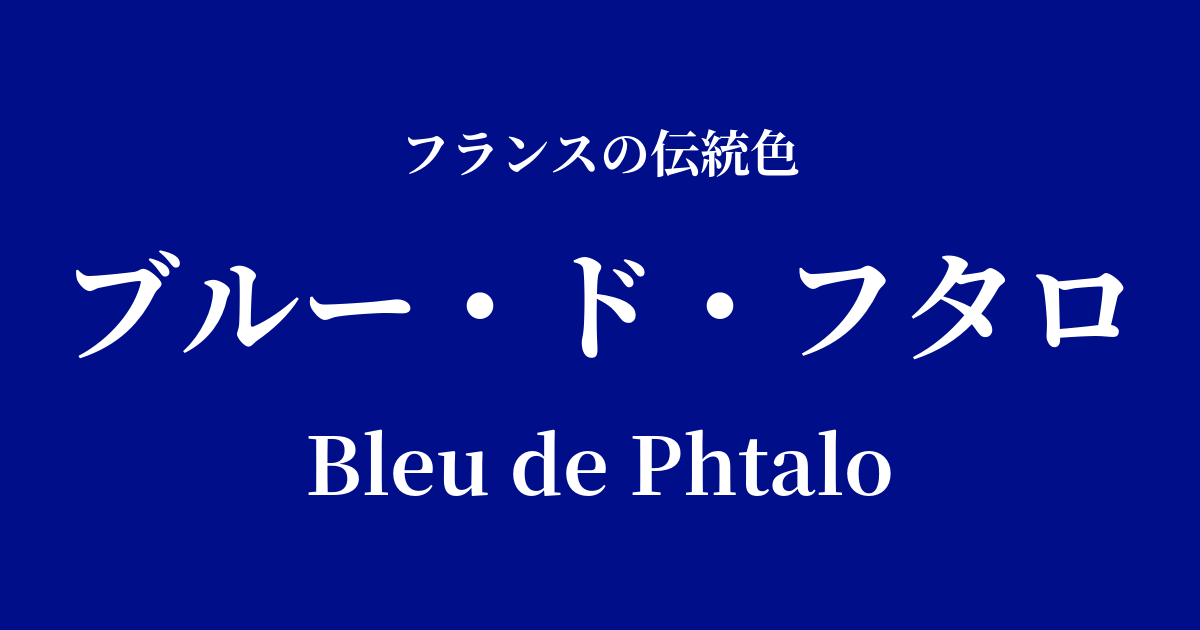
| French | Bleu de Phtalo |
|---|---|
| Katakana | Blue de Phthalo |
| HEX | #000f89 |
| RGB | 0, 15, 137 |
What is Bleu de Phthalo? Origin and Etymology
Bleu de Phtalo, as its name suggests, is an extremely vivid blue color derived from the chemical structure "phthalocyanine." The name is said to be a combination of "phthalic acid," a substance derived from petroleum, and "cyan," which means "blue" in Greek.
Unlike traditional natural pigments, this color is a modern synthetic pigment born from the advancements of 20th-century science and technology. Discovered accidentally in 1927 during a chemical experiment, this intensely blue substance underwent further research and development, leading to industrial production in the 1930s. Its exceptional durability, coloring power, and low production cost quickly made it a popular colorant for paints, inks, and plastics worldwide.
The historical background of Bleu de Phuthalot
Bleu de Phthalo is not a color with a medieval or early modern history, as might be associated with the term "traditional French color." Its history is deeply intertwined with the 20th century, particularly the contemporary art scene after World War II.
The greatest contributor to this color's special significance in the art world is the French artist Yves Klein. He was captivated by the vivid blue of this phthalocyanine pigment and developed a unique technique of mixing it with a special synthetic resin to preserve the pigment powder's inherent brilliance. This resulted in the creation of "International Klein Blue (IKB)," which has become synonymous with him.
For Klein, blue transcended nature, such as the sky and the sea, and symbolized the infinite and immaterial spiritual world. He created numerous monochrome paintings using IKB to paint the entire canvas, attempting to express the pure energy inherent in the color itself. Through the hands of the artist Yves Klein, blue de phthalote was elevated from a mere industrial product to an artistic color that invites philosophical contemplation.
Bleu de Phtharo in the world of art and fashion
The influence of Bleu de Phthalo on art is most symbolically represented in the work of Yves Klein. His monochrome paintings draw the viewer into a world of deep blue, giving a sense of infinite space beyond the physical canvas. This color inspired many artists who were searching for new forms of artistic expression in the postwar era.
In the world of fashion, this vibrant and powerful blue is highly valued as a color that conveys a modern and bold impression. In particular, it has appeared in haute couture and ready-to-wear collections as an accent color in the futuristic designs of the 1960s and in contemporary minimalist styles, captivating people's attention.
Furthermore, in our everyday lives, blue de phthalo is widely used as the main component of cyan, one of the basic colors in printing technology. The vibrant colors of magazines, posters, packaging, and all other printed materials would be impossible without this pigment. It is an extremely important color that fundamentally supports modern visual culture.
Blue has no dimensions. It transcends all dimensions.
Color scheme preview
This is to check the readability of the text when this color is used as the background.
Blue de Phthalo color scheme proposal
Blanc de Voile (#F2E8C9)
The vibrant blue of phthalo is gently complemented by the soft, ivory-like white. This combination is perfect for creating a sophisticated space that is both modern and warm.
Jaune d'Or (#FFD700)
The combination of deep blue and shimmering gold enhances each other to the fullest. It creates a dramatic impression, possessing both the opulence of royalty and the boldness of modern art.
Gris de Tourturelle (#B9B5AD)
The vibrant blue of the Phthalo is intellectually balanced by the calm gray of the Oriental Turtle Dove. It possesses an urban, minimalist feel, creating a cool and stylish impression.
Practical Scenes
In interior design, incorporating Bleu de Phthalo as an accent wall or art panel brings depth and a modern feel to a space. Even adding just one small item like a cushion, rug, or vase will tighten up the entire room and give it a sophisticated impression. It pairs particularly well with spaces based on white, gray, and natural wood tones.
In fashion, this color has a very strong presence. When used in statement pieces such as dresses and coats, it creates a bold and confident style. On the other hand, adding it as an accent color in accessories such as bags, scarves, and jewelry can give everyday outfits a modern touch.
In web and graphic design, its high visibility makes it effective for elements that you want to attract user attention, such as logos, buttons, and important headings. When used as a background, limiting the area and combining it with white or light gray text allows you to create an impactful design while maintaining readability.