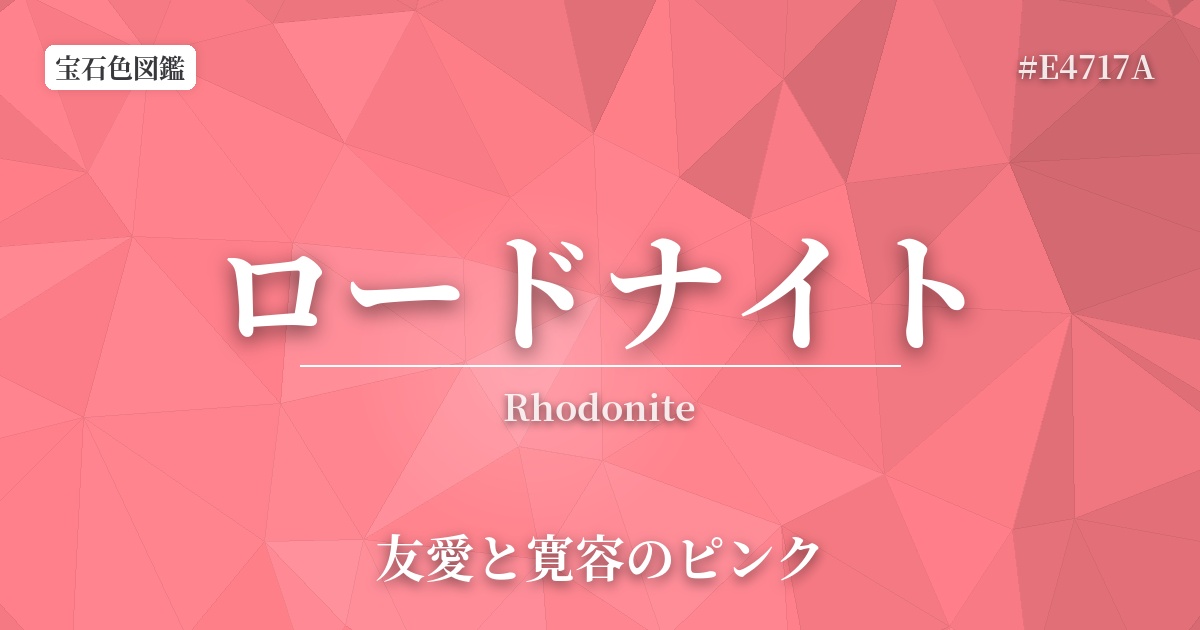
| English name | Rhodonite |
|---|---|
| Katakana | Rhodonite |
| HEX | #E4717A |
| RGB | 228, 113, 122 |
| Mineralogy | Silicate minerals |
What is rhodonite? Origin and mineralogy
The name rhodonite comes from the Greek word "rhodon," meaning "rose." As the name suggests, it is a gemstone characterized by its deep, beautiful pink to reddish-purple color, resembling rose petals.
As a mineral, it is classified as a silicate mineral with manganese as its main component. In Japanese, it is called "rose pyroxene," but it is important to note that it is not a mineral of the pyroxene group.
The most distinctive feature of rhodonite is the black, dendritic patterns that are often found within it. These are caused by manganese dioxide and are called "dendrites," creating a beautiful landscape on the stone's surface that resembles plant fossils or suminagashi (ink marbling). The contrast between these black patterns and the pink hues gives rhodonite its unique and profound appeal.
The main producing regions are spread across the globe, including Australia, Sweden, Russia, South Africa, Peru, and the United States. In particular, those produced in the Ural Mountains of Russia are known for their high quality.
The history and culture of rhodonite
Rhodonite became widely known as a gemstone after a large deposit was discovered in the Ural Mountains of Russia in the late 18th century. Due to its beauty, it was once treated as Russia's national stone and was affectionately known as "Orlets" (eagle stone).
The name "Orlets" is said to originate from a local legend in which eagles carry this stone to their nests to raise their chicks, giving them courage and strength. Due to its powerful image, it was once used in the tombstones of Russian emperors, the interiors of palaces, and the decoration of works by Fabergé, and was cherished as a stone symbolizing national prestige.
Rhodonite and Color Psychology
The warm pink color of rhodonite symbolizes love, gentleness, and a sense of security. It is believed to have a calming effect on the viewer, easing stress and anxiety. In particular, rhodonite with black markings evokes a sense of stability and strength, like the energy of the earth, within its gentle pink hue.
Known as the "stone of friendship," rhodonite is said to foster compassion and tolerance towards others, and to support smooth interpersonal relationships. It is also a popular power stone that helps balance mind and body, bring out hidden passions and talents, and boost self-esteem.
Color scheme preview
This is to check the readability of the text when this color is used as the background.
Rhodonite color scheme proposal
Dove Gray (#B3B3B3)
The warm pink of rhodonite combined with the calm and intellectual impression of dove gray creates a sophisticated, mature atmosphere. It's an elegant and calming color scheme.
Verde Salvia (#87AE73)
This natural combination evokes the image of rose petals and leaves. The vitality of rhodonite's pink harmonizes with the calmness of sage green, creating a relaxing and gentle impression.
Cream (#FFFDD0)
The vibrant pink of rhodonite is gently complemented by the softness of cream. This color combination is bright and feminine, yet somehow classic and elegant.
Practical Scenes
As jewelry, it is processed into cabochon cuts and beads, and is popular as necklaces, bracelets, and earrings. In particular, designs that make use of the black dendrite pattern are loved as one-of-a-kind pieces, each with its own unique appearance.
In the field of interior design, using it in decorative items, accessories, and tabletops can add warmth and a sophisticated accent to a space. It harmonizes well with modern spaces based on pink, gray, and white tones.
In web and graphic design, using it as an accent color can create a sense of approachability and elegance. It is particularly effective in enhancing the brand image of services, wellness, and lifestyle-related brands targeting women.