
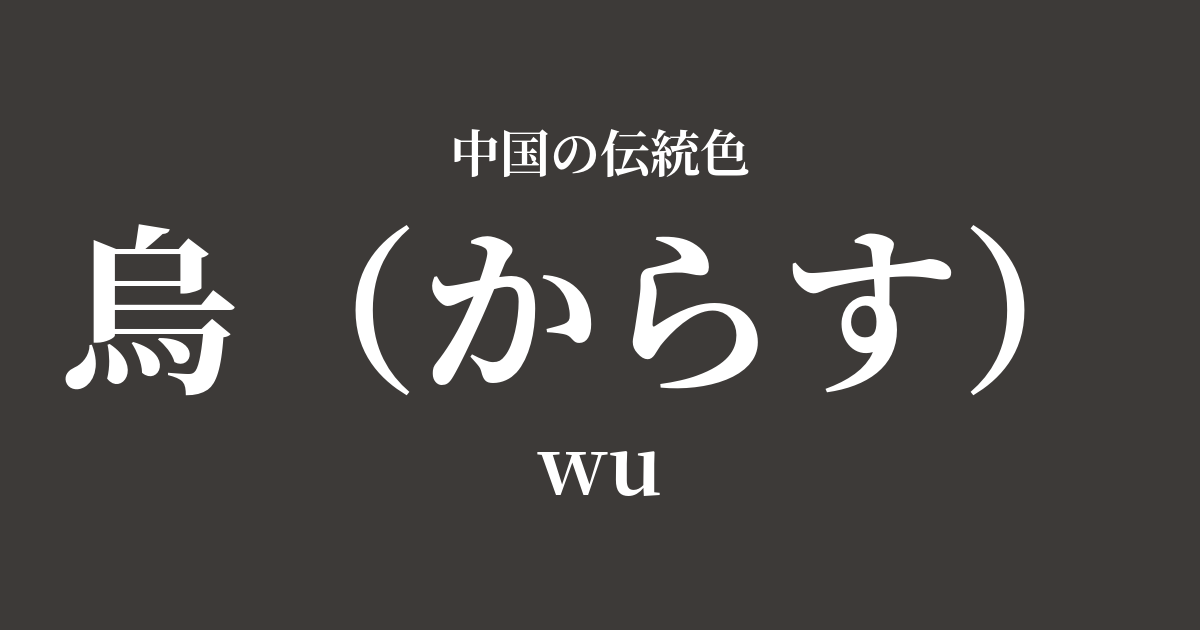
| Color name | 烏 |
|---|---|
| reading | crow |
| pinyin | wu |
| HEX | #3D3A38 |
| RGB | 61, 58, 56 |
What does 乌 mean? Origin and etymology
"乌 (烏)" is a deep black color derived from the color of a crow's feathers, as its name suggests. It's not simply a solid black, but rather a complex and nuanced shade that can appear slightly brownish or grayish depending on the lighting.
The kanji character "烏" (crow) was created by removing one stroke from the character "鳥" (bird), which represents the eye. This is said to have originated from the fact that crows' bodies are black, making their eyes difficult to distinguish, and the character itself reflects the characteristic color.
In ancient China, crows were not necessarily considered ominous birds. In mythology, it was believed that a three-legged crow, known as "Sansokuu," lived in the sun, and crows were sometimes seen as symbols of the sun and, by extension, auspicious signs. For this reason, the character "乌" was not merely the color of darkness, but also carried a mystical hue associated with the sun, the source of life.
Historical background of the O
In Chinese history, black has been a color with special significance. In particular, Qin Shi Huang, the first emperor to unify China, designated black, the symbol of "water" in the Yin-Yang Five Elements philosophy, as the most revered color. As a result, everything from the emperor's ceremonial robes to the uniforms of officials, palace decorations, and flags was unified in black, and deep black, like the character "乌," became a color that represented the authority and power of the state.
Even as red and yellow became more favored as auspicious colors after the Han dynasty, the solemnity and dignified nature of black remained. In particular, the hats worn by government officials were called "usha-bo" and were made of black gauze. These hats would be passed down through generations as a symbol of public status and intellectual status.
In this way, the character "乌" has taken deep root in Chinese culture as a symbol of power, law, and intellect, as time has passed.
In Chinese art and crafts
The profound hue of the character "乌" truly shines in Chinese art, especially in the world of ink painting. Ink painting is an art form that uses varying shades of black to represent all things. A deep black like that of "乌" is an important element for creating the powerful outlines of mountains, deep shadows, and for tightening the overall composition. It is not merely a color, but an expressive technique that evokes a sense of stillness and infinite space.
In clothing culture, black was a highly dignified color used in ceremonies and formal occasions. In the ceremonial dress system of the Zhou dynasty, the emperor's sacrificial robes were designated as "Xuanyi Kunshang," and he wore a black upper garment (Xuanyi). This tradition influenced later generations, and black, such as the character "乌," continued to hold special significance as a color that embodied solemnity and dignity.
Furthermore, a beauty similar to that of "乌" can be seen in ceramics using black glaze, such as Tenmoku tea bowls made in the Jian kilns of Fujian Province. The oil droplets and iridescent patterns that emerge from the jet-black glaze resemble stars shining in the night sky, and their mystical beauty has captivated many people.
moonfall crow frost full sky
Color scheme preview
This is to check the readability of the text when this color is used as the background.
Poo's color scheme suggestion
Cinnabar (#FF4D4D)
The combination of the powerful and vibrant "Cinnabar" and the profound "Wu" is a traditional color scheme often seen in Chinese palace architecture and ceremonial decorations. The two colors complement each other, creating a dignified and dramatic impression.
Tsukihaku (#EAEAE1)
By combining it with the soft "moon white" reminiscent of moonlight, the weightiness of "乌" is softened, creating a quiet and refined atmosphere. It is an elegant color scheme that evokes the beauty of stillness and negative space, like an ink painting.
Yellow (#FFD700)
The combination of "Asplenium," a brilliant yellow color associated with the emperor, and "乌," a character symbolizing authority, expresses the highest level of elegance and luxury. It has a sophisticated feel and creates a glamorous impression that attracts the viewer's attention.
Practical Scenes
In interior design, the color "乌" (乌) is ideal as an accent color that brings a sense of weight and tranquility to a space. Incorporating it into one wall or large piece of furniture will tighten the overall look of the room, creating a modern and sophisticated impression. When combined with moon white, off-white, and warm wood tones, it can create a quiet, comfortable, and meditative space.
In the world of fashion, "乌" (wu) is a timeless and universally loved color. Incorporating it into high-quality coats, dresses, or leather accessories adds elegance and sophistication to your outfit. While an all-out look in this color is powerful, using a vibrant color like cinnabar as an accent color creates an even more striking style.
In website and graphic design, using the character "乌" as a background color can effectively convey a sense of luxury and expertise. Incorporating light blue or gold into text and logos enhances readability while simultaneously helping to build an elegant and trustworthy brand image.