
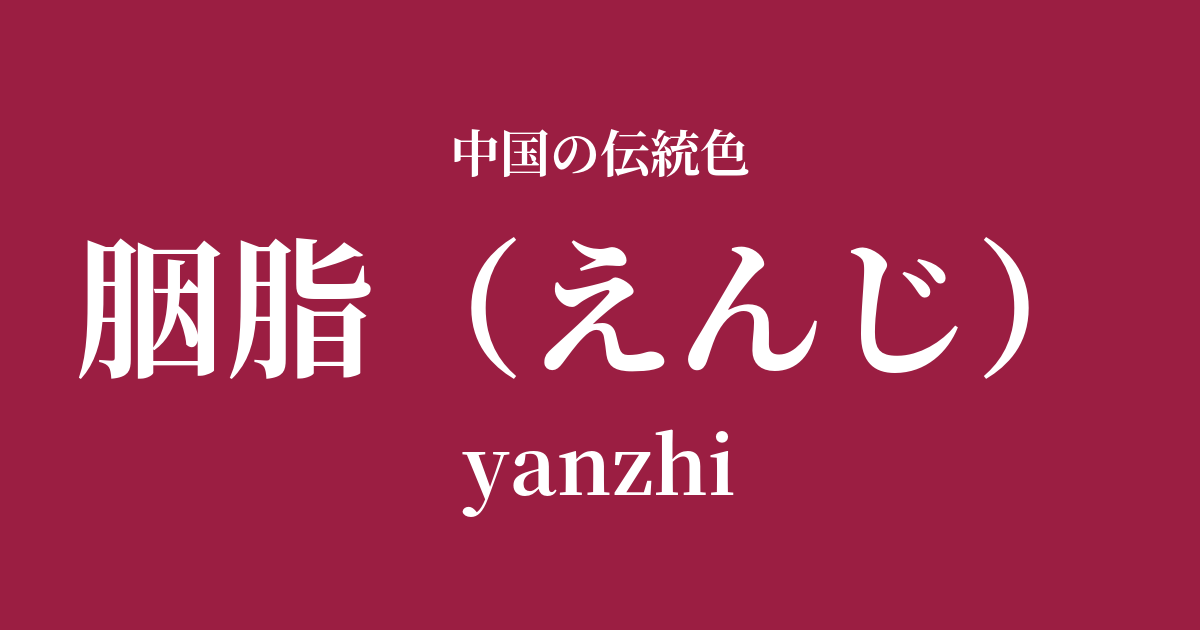
| Color name | fat |
|---|---|
| reading | maroon |
| pinyin | yanzhi |
| HEX | #9B1E42 |
| RGB | 155, 30, 66 |
What is rouge? Origin and etymology
"Enji" refers to the blush and lipstick made from the petals of the safflower, and also to the vibrant red color. In the past, it was also written as "Enshi" or "Enshi".
There are several theories about its origin, but one theory suggests that it derives from the fact that the Xiongnu, a nomadic people from before the Common Era, called the king's principal wife "Yanshi." It is said that because these women used safflower to make their makeup, the cosmetics themselves came to be called "Yanshi."
Another strong theory suggests that the name of the color and its use in cosmetics originated from the fact that Mount Yanzhi, located within the territory of the Xiongnu, was a famous production area for safflower. In any case, this color is not merely a name for a color, but a word that holds a rich story, symbolizing the beauty of women and the culture of cosmetics itself.
Historical background of rouge
The history of rouge is ancient; legend says that King Zhou of the Shang (Yin) dynasty favored textiles dyed with safflower. However, it wasn't until the Han dynasty, when Zhang Qian brought safflower cultivation techniques from the Western Regions, that rouge became widely used as a cosmetic. This led to the full-scale production of rouge, and it became popular among many women.
During the Tang Dynasty, rouge culture reached its peak. In this era of open and vibrant culture, women's makeup became bolder and more vivid. In particular, Yang Guifei, known as a woman of unparalleled beauty, is said to have loved rouge, and the "peach blossom makeup" that adorned her cheeks became the object of admiration for many women. Many poems from this era compare the beauty of women to the red color of rouge.
From the Song Dynasty onward, rouge remained a beloved essential for women. Beyond its use as a cosmetic, it was also employed as a dye for high-quality silk and as a pigment to depict the complexion of figures in paintings, becoming deeply rooted in Chinese color culture. Its color transcends mere trends and fads, remaining to this day as one of the colors symbolizing Chinese aesthetics.
Rouge in Chinese Art and Crafts
Rouge has played a significant role in Chinese clothing culture, particularly in Hanfu. Garments made from lustrous silk fabrics dyed in this color possessed both nobility and splendor, making them popular among court ladies. The use of this color in the rich and elegant silhouettes of women's clothing, especially those depicted in Tang Dynasty portraits, conveys the opulent culture of that era to this day.
In the field of fine art, this color is indispensable for depicting figures in the art of meticulous brushwork (kohitsuga). By applying a thin layer of rouge to the lips and cheeks of women depicted in portraits of beautiful women, a vibrant, healthy complexion and lustrous sheen are created, giving the figure a sense of life. The delicate brushstrokes even express the translucency of the skin.
Furthermore, the name "rouge" is sometimes used to describe the color of glaze used in ceramics, and its vibrant red color adds a magnificent touch to the vessels.
Swallow fat
Color scheme preview
This is to check the readability of the text when this color is used as the background.
Rouge color scheme proposals
Tsukihaku (#EAEBE6)
The deep red of the rouge and the pure, pale color of the moonlight contrast with each other, yet they complement one another. It gives an elegant and refined impression, like the silk garments worn by women in the royal court.
Female yellow (#FFC64B)
The vibrant red of the rouge and the vivid yellow of the orpiment create a bold and lively color scheme, reminiscent of Tang Dynasty sancai pottery. It evokes a festive splendor and a powerful energy that captivates the viewer.
Mayuzumi (#495859)
The deep, bluish-black of the mayuzumi tones down the vibrancy of the rouge's red, while highlighting its depth. This color scheme evokes the allure of nighttime and a sense of hidden passion, creating a mature, grown-up atmosphere.
Practical Scenes
In the world of fashion, rouge is a very striking accent color. Simply incorporating it into dresses, blouses, or scarves instantly brightens the entire outfit and creates a passionate atmosphere. Choosing this color as a lip color, in particular, enhances skin radiance and makes your face look more vibrant.
In interior design, it's recommended to use rouge partially in items such as cushions, curtains, and artwork. It adds warmth and dramatic elements to a space, creating a sophisticated and luxurious atmosphere. Combining it with neutral colors like white, gray, and black further enhances the power of rouge's color.
In web and graphic design, it's effective to use it for buttons or important headings that you want to attract the user's attention. By using a light color as a background and rouge as an accent color, you can achieve both visual impact and an elegant impression.