
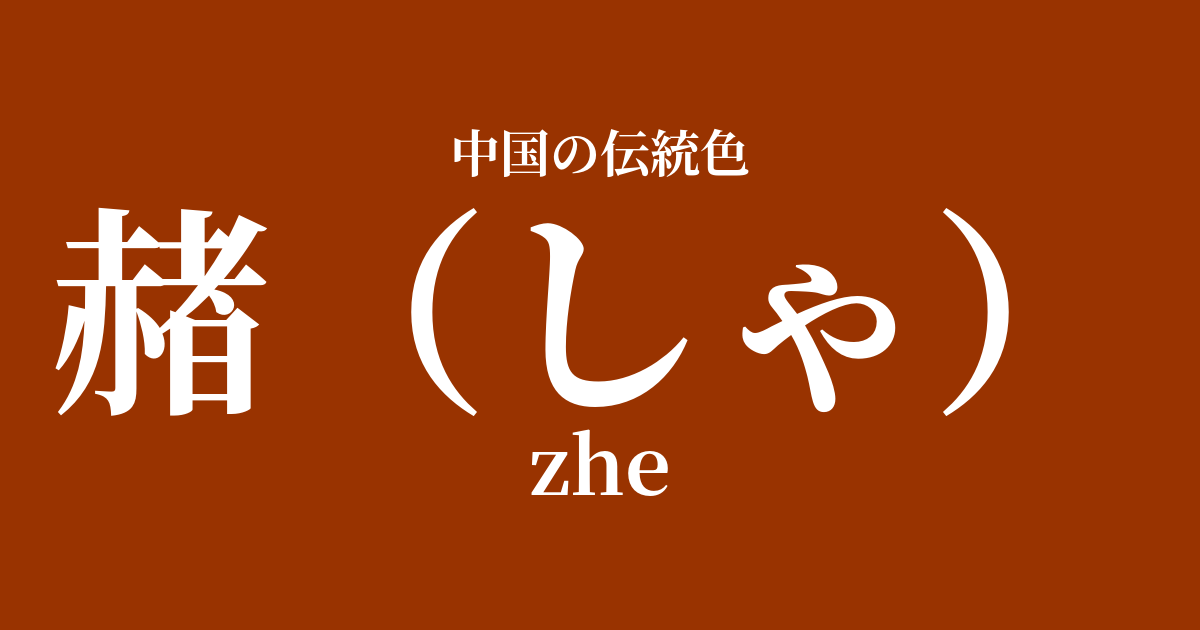
| Color name | 赭 |
|---|---|
| reading | Sha |
| pinyin | zhe |
| HEX | #993300 |
| RGB | 153, 51, 0 |
What does "Ocha" mean? Origin and etymology
The color "sha" (赭) is a deep, yellowish-reddish-brown, derived from "shado" (赭土), a reddish soil whose main component is hematite. The kanji character "赭" is a combination of "red" (赤) and "person" (者), and literally means "red soil."
It is one of the oldest pigments used by humankind, and because it can be obtained simply by crushing and refining natural clay, traces of it can be seen in cave paintings and other artifacts around the world. In China, its use has also been confirmed in the patterns of Neolithic pottery, making it a color with a long and rich history.
Historical background of ochre
The color ochre (赭) has had two contrasting meanings in Chinese history. One is its aspect as a majestic color used to adorn the pillars and walls of palaces. The "Records of the Grand Historian" describes the Epang Palace built by Qin Shi Huang as the "Palace of Ochre and Clay," giving us a glimpse of a magnificent palace painted red with ochre and white with clay. Thus, in architecture, ochre was used as a symbol of authority and wealth.
On the other hand, ochre was also a color that symbolized "crime." During the Zhou dynasty, the color of clothing worn by criminals was designated as ochre, and it was called "ochre clothing (shai)." There are various theories as to why this was the case, such as that ochre resembled the color of blood, or that it was close to the color of clothes soiled by forced labor. This custom continued into later generations, and it appears in literary works and other contexts as a term to refer to criminals or prisoners.
Ochre in Chinese Art and Crafts
Ochre has played an important role in various fields of Chinese art. In painting in particular, the pigment known as "ochre stone" or "alternative ochre stone" is indispensable. In landscape painting, it is used to depict mountain slopes, rocks, withered trees, and building roofs, giving the work warmth, realism, and a calm elegance.
Furthermore, in ancient Buddhist murals, such as those found in the Mogao Caves of Dunhuang, ochre is used extensively to depict the skin tones, clothing, and backgrounds of the figures. The fact that its color has not faded even after thousands of years demonstrates its high durability as a natural pigment.
In the field of ceramics, from the patterns on painted pottery of the Neolithic period to the reddish-brown pottery of the Han dynasty, ochre has long been a familiar and basic color used to decorate the surface of vessels.
Next, hair and hair, young hair, humiliation and abuse, half-dressed, unsupervised, and later reprimanded.
Color scheme preview
This is to check the readability of the text when this color is used as the background.
Red color scheme proposal
Black (#333333)
The warmth of the earth in ochre combined with the serenity of ink creates a traditional and dignified impression reminiscent of calligraphy and ink painting. It is an intellectual color scheme that creates a sense of calm within its strength.
Yellow (#FFD700)
The reddish-brown of ochre and the vibrant yellow of orpiment create a warm and vibrant color scheme reminiscent of fertile land and autumn harvests. It is energetic yet harmonious.
Tsukihaku (#EAF4FC)
The combination of deep ochre and clear moon white creates a beautiful contrast. This color scheme gives an elegant and sophisticated impression, making it suitable for Japanese modern spaces and designs.
Practical Scenes
In interior design, ochre is an ideal accent color that brings warmth and a sense of depth to a space. Incorporating it into one wall, or using it in fabrics such as sofas, cushions, and rugs, can create a calm and sophisticated atmosphere. It pairs particularly well with wooden furniture and houseplants.
In fashion, ochre is particularly appealing in autumn and winter outfits. Incorporating it into key items such as coats, jackets, and knitwear creates an intelligent, sophisticated, and mature atmosphere. It's also recommended to use it in leather goods such as bags, shoes, and belts.
In web and graphic design, it's effective when you want to convey an image of trustworthiness, history, and tradition. It's ideal for websites of established brands, cultural content, and packaging for organic products—anywhere you want to project a grounded and authentic impression.