
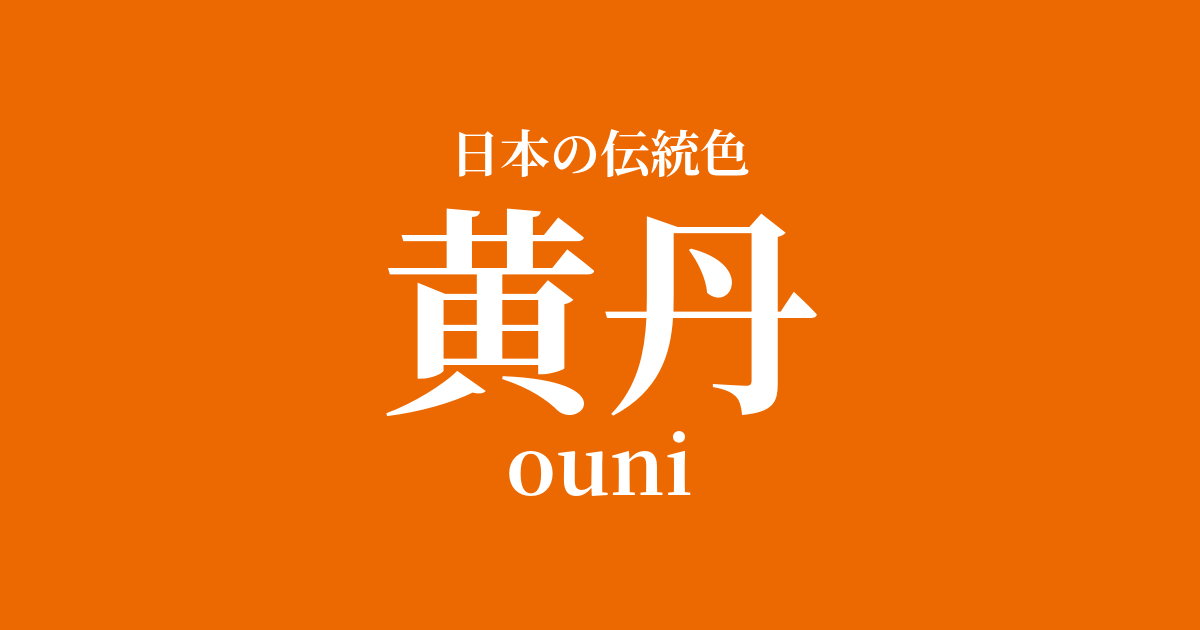
| Japanese color name | Huangtan |
|---|---|
| reading | ouni |
| HEX | #EC6800 |
| RGB | 236, 104, 0 |
What is yellow ochre? Origin and etymology
Ouni is a color created by combining a yellow pigment extracted from gardenia fruit with a red pigment obtained from safflower petals. As the names "yellow" and "ni" suggest, it refers to a reddish-yellow or yellowish-orange color. This dyeing method has been established since ancient times, and it can be found in the Engishiki, a legal code from the Heian period. It is said that this deep and vibrant color is created by first dyeing with gardenia and then dyeing with safflower.
The color was thought to symbolize the rising sun, especially the morning sun that colors the sky at dawn. The sun has been considered sacred since ancient times and has been particularly associated with Amaterasu, the ancestral deity of the Imperial family. Therefore, orange was not merely a beautiful color, but a color with extremely sacred and noble meanings, and was given a special status. This idea became the background for its later designation as the Crown Prince's color.
Historical background of yellow orange
The history of the color Ōni (a type of yellow-orange dye) begins with the establishment of the Ritsuryo system (ancient Japanese legal and administrative system). In the clothing regulations of the Taihō Code, enacted in 701 AD, it was officially designated as the color of the Crown Prince's robe. Along with the "Kōrozen" (another type of yellow-orange dye) worn by the Emperor, it was designated as one of the "forbidden colors" whose wearers were strictly restricted. This regulation strictly prohibited anyone other than the Crown Prince from wearing Ōni.
This system was strictly observed even after the Heian period, and orange became established as a color symbolizing the authority and sanctity of the Crown Prince. It became customary for the Crown Prince to wear an orange robe during court ceremonies and events, and this image is depicted in literary works and other forms of literature. Even as time passed, its special status remained unchanged, and it has been passed down through Japanese history and culture as an important color symbolizing imperial succession.
Related literature, waka poetry, and seasonal words
Yellow-orange, a color associated with nobility, frequently appears in Heian period literature. In "The Tale of Genji," yellow-orange garments are depicted as the attire of the protagonist, Hikaru Genji, when he was a prince, and also when his son, Emperor Reizei, was the Crown Prince. Within the story, this color plays a symbolic role in indicating the high status of the characters and their special status as beings connected to the imperial throne.
Furthermore, although there aren't many waka poems that directly mention the color orange, the "morning sun" and "dawn" that this color symbolizes have been themes that many poets have favored. The scene of night breaking and the sky taking on reddish and yellowish hues evokes hope and new beginnings. It can be said that the color orange is deeply connected to this worldview of waka poetry.
Color scheme preview
This is to check the readability of the text when this color is used as the background.
Yellow-orange color scheme proposal
Dark purple (#493759)
Deep purple has long been considered a symbol of high rank. When combined with yellow-orange, the color of the Crown Prince, it creates a very dignified and majestic atmosphere. This color scheme has a historical background and is suitable for occasions that value traditional designs and formality.
Light green (#A9D159)
Moegi is a vibrant green reminiscent of young leaves. When combined with ōni, the color of the rising sun, it creates a bright and hopeful color scheme that evokes the arrival of spring and youthfulness. It blends naturally with Japanese aesthetics and gives a cheerful impression.
Blue and white (#EBF4F3)
Indigo white is a very pale, bluish-white, possessing a sense of cleanliness and elegance. When combined with vibrant orange, the two colors complement each other, creating a clean, sophisticated, and modern impression. It is particularly effective in designs that utilize negative space.
Practical Scenes
In the world of kimono, due to its historical significance as a forbidden color for the Crown Prince, it has traditionally been avoided by ordinary people as the base color of a kimono. However, its dignified hue is sometimes incorporated as an accent, such as in obi sashes, obi ties, or as part of a pattern. In particular, using it partially in formal kimono adds elegance and splendor.
In interior design, orange is an effective accent color that adds warmth and a sense of luxury to a space. Incorporating orange into cushion covers, parts of wallpaper, or artwork creates a focal point that draws the eye. When paired with a simple space based on white or wood tones, the color stands out, creating a modern Japanese atmosphere.
In web and graphic design, this color can be used to convey an energetic and positive impression. It is effective when used on buttons, headings, or parts of logos that you want to attract attention. It is suitable when you want to express the strength and tradition of a brand, and when used against a white or dark gray background, the vibrancy of the yellow-orange color stands out while maintaining readability.