
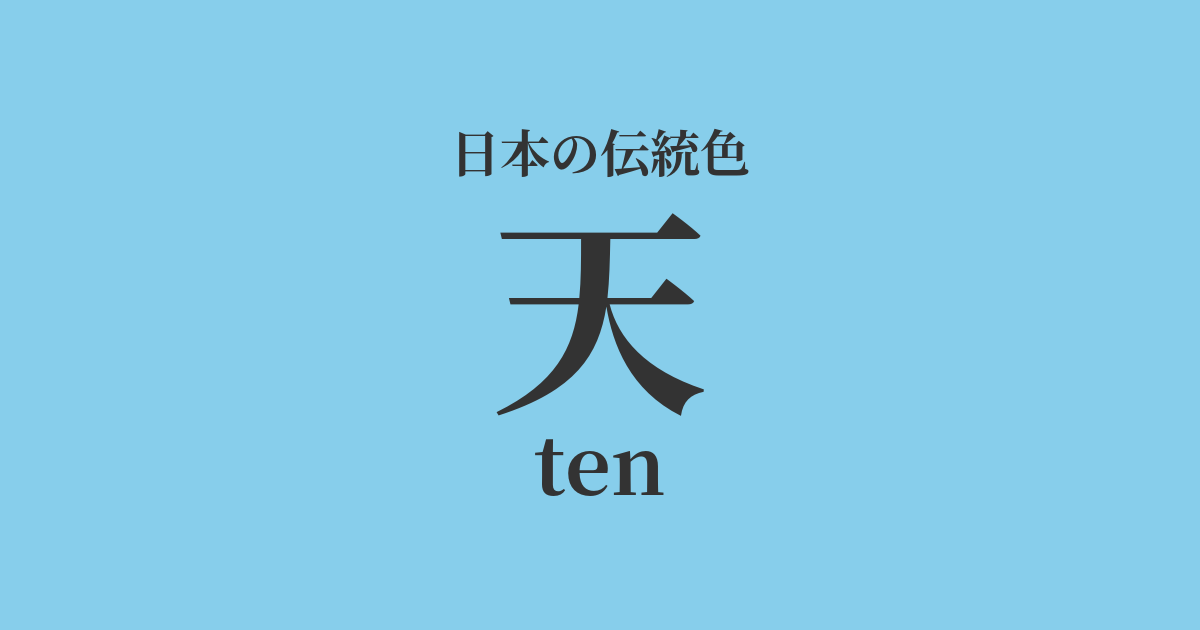
| Japanese color name | 天 |
|---|---|
| reading | ten |
| HEX | #87CEEB |
| RGB | 135, 206, 235 |
What is "Ten"? Origin and etymology
"Ten," as its name suggests, derives from the color of the clear sky on a sunny day. It is the equivalent of the English word "sky blue" and evokes an image of vastness and openness. It is considered a relatively new color name among traditional Japanese colors, as words such as "sorairo" (sky blue) and "hanadairo" (indigo blue) have long been used to refer to the color of the sky. In modern times, with the influx of Western color culture, it is thought that the name "Ten" became established as a more specific and vivid color for the sky.
The historical background of the heavens
The color name "Ten" (天) only clearly appears in the Japanese color system in modern times. In literature from before the Edo period, "Ten" is rarely found as a specific name for this color. In the Meiji era, when new color concepts were introduced from the West along with chemical dyes, it is believed that "Ten-iro" (天色) came to be used as a translation for "sky blue."
Therefore, rather than being colors rooted in ancient manufacturing methods such as plant dyes, they are positioned as traditional Japanese colors named from a modern perspective.
Related literature, waka poetry, and seasonal words
While classical literature rarely directly uses the color name "heaven," the sky has long been an important motif in Japanese literature. In many waka poems, including those in the *Manyoshu* and *Kokin Wakashu*, the blueness and vastness of the sky are celebrated, and it has been depicted as a symbol of people's feelings and the changing seasons. Numerous words related to the sky also exist as seasonal words, such as "autumn sky" (shūten) and "Milky Way" (amanogawa).
These can be said to reflect the Japanese people's aesthetic sense and reverence for the sky.
Color scheme preview
This is to check the readability of the text when this color is used as the background.
Heaven's color scheme proposal
White training (#FEFFDFD)
The bright blue of the sky and the pure white of the white evoke images of a clear sky and the clouds floating within it. This combination is incredibly harmonious, exuding a sense of cleanliness and freshness, and bringing a sense of spaciousness and brightness to the space.
Lemon color (#FFF450)
The sky blue and the cheerful lemon yellow evoke the bright sunshine and clear blue sky of a sunny day. This color scheme gives a positive and energetic impression, making viewers feel cheerful and hopeful. It's also suitable for children's designs.
Coral color (#F58F98)
By combining cool-toned sky colors with warm-toned coral colors, a near-complementary color relationship is created where each color enhances the other. The result is a vibrant and striking color scheme, reminiscent of the gradients between the sky and sunrise or sunset.
Practical Scenes
Its refreshing and cool hue makes it a popular base color for yukata and summer kimonos. Pairing it with white or yellow for obi sashes and accessories creates a youthful and cool look. It's also frequently incorporated into modern fashion, appearing in shirts and dresses.
In interior design, using it in wallpaper or curtains brings a sense of openness and brightness to the entire room. It is especially suitable for spaces where concentration or relaxation is desired, such as children's rooms or studies. Using it as an accent color in small items such as cushions and rugs is also effective.
In the field of web design, it is often used in corporate websites, as well as medical and educational websites, because it gives a clean and trustworthy impression. Using it as a background color or button color can give users a sense of security and familiarity.