
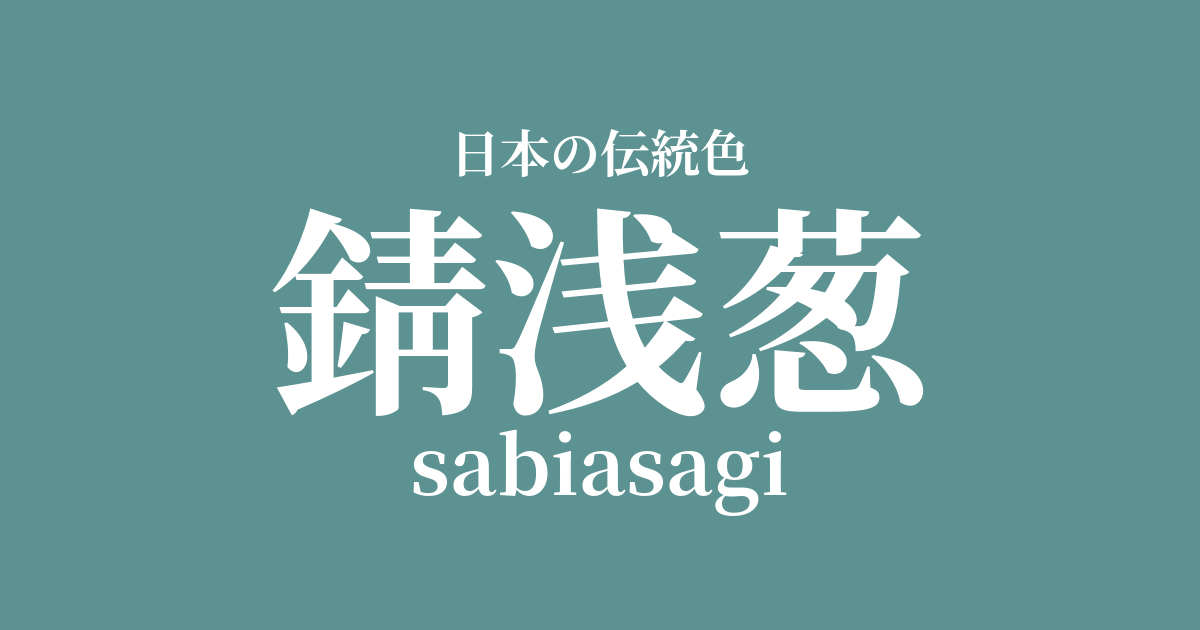
| Japanese color name | Rusty light green |
|---|---|
| reading | sabiasagi |
| HEX | #5C9291 |
| RGB | 92, 146, 145 |
What is Sabiasagi? Origin and etymology
The color name "Sabi Asagi" is a combination of "Asagi-iro," which refers to a bright blue-green color, and "Sabi," a prefix meaning a muted or dull hue. While Asagi-iro derives its name from the color of young onion leaves, Sabi Asagi is characterized by a more subdued, calm, and sophisticated tone with reduced saturation. Here, "Sabi" does not directly refer to the color of rust caused by the oxidation of metal, but rather is used to express a restrained yet profound hue that resonates with the aesthetic sensibilities of "Wabi-Sabi."
Many color names prefixed with "rust" originated in the Edo period, including "sabionando" and "sabirikyu." These were part of a subtle color culture that developed under sumptuary laws, exemplified by "shijuhacchahyakunezumi" (forty-eight shades of brown and one hundred shades of gray). The Edo common people's aesthetic sense, which avoided flashy colors and valued subdued yet refined colors as "chic," is thought to be the background behind the creation of complex intermediate colors like sabiasagi.
Historical background of rusty light blue
Rusty light blue only became widely known from the mid-Edo period onward. Repeated sumptuary laws imposed by the shogunate restricted commoners from wearing brightly colored clothing. As a result, a culture flourished where people appreciated subtle variations in color within subdued shades such as brown, gray, and indigo.
Rusty light blue was one of the fashionable colors known as "forty-eight shades of brown and one hundred shades of gray," and was beloved by the townspeople of Edo. In particular, its popularity soared when Kabuki actors incorporated it into their stage costumes, and it is said to have spread among the common people as a stylish color. This color, which is calm yet somehow sophisticated, can be said to be one of the colors that symbolizes the aesthetic sense of Edo.
Related literature, waka poetry, and seasonal words
Because "sabi-asagi" (rusty light blue) is a relatively new color name that originated in the Edo period, it is not found in classical literature such as the "Manyoshu" or "The Tale of Genji." This color appears in literary works mainly in Edo period works that reflect townspeople's culture, such as sharebon, kibyoshi, and ninjobon. In these works, it is depicted as the color of the stylish kimono worn by the characters, playing a role in conveying the customs and fashions of the time.
Furthermore, rusty light blue is not designated as a specific seasonal word. However, its subdued, muted blue-green color evokes the calm atmosphere of late summer through autumn, and the slightly faded colors of plants and trees. For this reason, it is sometimes used in haiku and tanka poetry to describe autumn scenes.
Color scheme preview
This is to check the readability of the text when this color is used as the background.
Suggested color scheme for rusty light blue
White tea (#B59778)
The calm blue-green of rusty light blue and the soft beige hues of white-brown complement each other beautifully. This color scheme creates a natural and tranquil impression, emphasizing a Japanese aesthetic. It is suitable for interior design and coordinating with Japanese clothing.
Persimmon color (#ED7D31)
The warm orange of persimmon, a color close to its complementary hue, creates a vivid contrast with the bluish-green of rusty light blue. This combination enhances each other's colors, achieving both vibrancy and depth. It is effective as an accent color for accessories and designs.
Black (#333333)
The subdued hues of the rusty light blue are toned down by the neutral ink black, creating a modern and sophisticated impression. The colors aren't overpowering, resulting in a chic and urban atmosphere. It can be used in a wide range of fields, including web design and fashion.
Practical Scenes
Because it was a popular color during the Edo period, it is often used in traditional Japanese clothing, especially kimonos, obi sashes, and accessories. It gives a sophisticated and refined impression, making it a popular color even today, favored by connoisseurs. Incorporating it into everyday kimonos, such as those made of tsumugi silk or komon pattern, creates a stylish look.
In interior design, incorporating this color into fabrics such as wallpaper, curtains, and cushions brings a sense of calm and Japanese aesthetics to a room. It pairs well with wood and is suitable for natural modern spaces and Japanese modern interiors. Because it's a subtle color, it doesn't create a feeling of oppression even when used over a large area.
In web design, using this color as a background or accent color for a site can convey a sense of reliability and calmness. It is particularly effective as an image color for websites dealing with traditional crafts or for brands that want to project a quiet and intellectual atmosphere.