
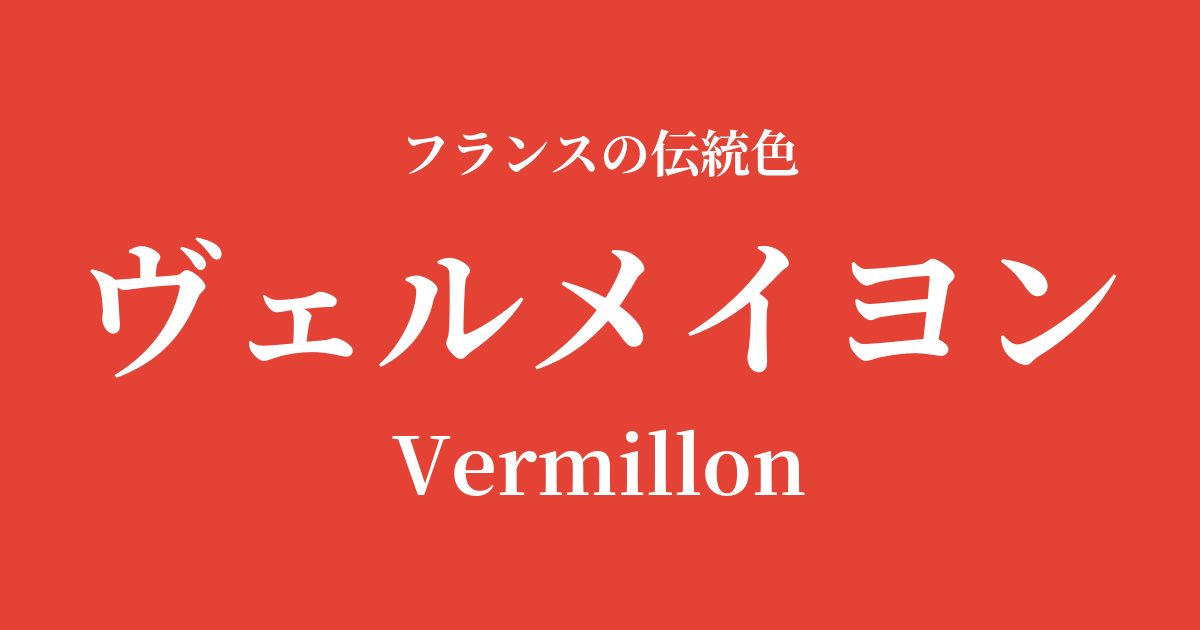
| French | Vermillon |
|---|---|
| Katakana | Vermeillon |
| HEX | #e34234 |
| RGB | 227, 66, 52 |
What is vermeilon? Origin and etymology
Vermillon is a vibrant, slightly yellowish red color, equivalent to the Japanese word "shuiro" (vermilion). Its name comes from the Latin word "vermiculus," meaning "small insect." This is said to be because it was historically confused with crimson, a red pigment extracted from the scale insect called kermes.
However, the original raw material for the pigment known as vermeil is the mineral "cinnabar," or mercury(II) sulfide. This pigment, made by crushing and refining this naturally occurring red ore, has captivated people with its vivid color since ancient times and has been treated as extremely expensive and precious. It is a color name with an interesting history, where the origin of the name and the actual raw material are different.
The historical background of Vermeillon
Vermeilon has a long history, with records showing its use in frescoes and other artwork as early as ancient Roman times. Due to its rarity and vividness, it was considered a symbol of power and sanctity.
In medieval Europe, vermeilon became an indispensable color for illuminated manuscripts (miniatures). It was used lavishly, alongside gold, especially to adorn important biblical phrases and initials. The brilliant red of this pigment was believed to give a sacred light to the word of God.
During the Renaissance, as oil painting techniques developed, many masters favored this color. In France, vermeilon was frequently used as a symbol of wealth and power in royal portraits and lavish court decorations. Especially during the opulent period of the 17th and 18th centuries, this color was indispensable for demonstrating the prestige of royalty and nobility.
Vermeilon in the world of art and fashion
Vermeilon has graced the palettes of many painters throughout Western art history. In particular, the Venetian school of the Renaissance, which emphasized light and color, and Rubens of the 17th-century Flemish school, effectively used this color in the clothing of their figures and in the backgrounds. Its influence can also be seen in the deep red of the drapery painted by Dominique Ingres, a master of French Neoclassicism.
In the world of fashion, red is deeply intertwined with French court culture. From the opulent garments of Louis XIV's era to the official ceremonial attire of the Napoleonic Empire, red has always held a special place. Even in contemporary haute couture, vibrant reds like vermeil continue to inspire designers as a color that conveys a dramatic and passionate impression.
Furthermore, this vibrant red has been used as a key design element in high-end textiles such as the silk fabrics of Lyon, France, and the tapestries of the Royal Gobelins Manufactory, enhancing their artistic value.
Color scheme preview
This is to check the readability of the text when this color is used as the background.
Vermeilon color scheme proposal
Noir (#000000)
When combined with black, the vibrancy of vermeil stands out, creating a very dramatic and powerful impression. It also evokes a dignified and modern atmosphere, reminiscent of Japanese lacquerware.
All (#FFD700)
The combination of gold and other colors is one of the most luxurious, historically symbolizing royal and religious authority. It's an ideal color scheme for creating a festive, dazzling, and extraordinary atmosphere.
Gris de Ran (#d2c9c0)
The gentle gray, reminiscent of flax, softly complements the strong presence of vermeilon, creating a sophisticated and modern impression. The color scheme is elegant yet warm.
Practical Scenes
In interior design, vermeil is an ideal accent color that brings energy and vibrancy to a space. Even incorporating it on just one wall, or adding it to small items like cushions, artwork, or vases, can dramatically enhance the overall impression of a room. It harmonizes particularly beautifully with classical or oriental-inspired interiors.
In fashion, vermeil dresses and coats are statement pieces that attract attention. For more everyday use, it's effective to use it as an accent color around the face or in an outfit, such as a scarf, bag, or lip color. It brightens the complexion and creates a vibrant look.
In web and graphic design, its high visibility makes it suitable for call-to-action buttons and important headings that you want to draw attention to. However, overuse can be overwhelming, so it's recommended to use it only as an accent, considering the overall balance.