
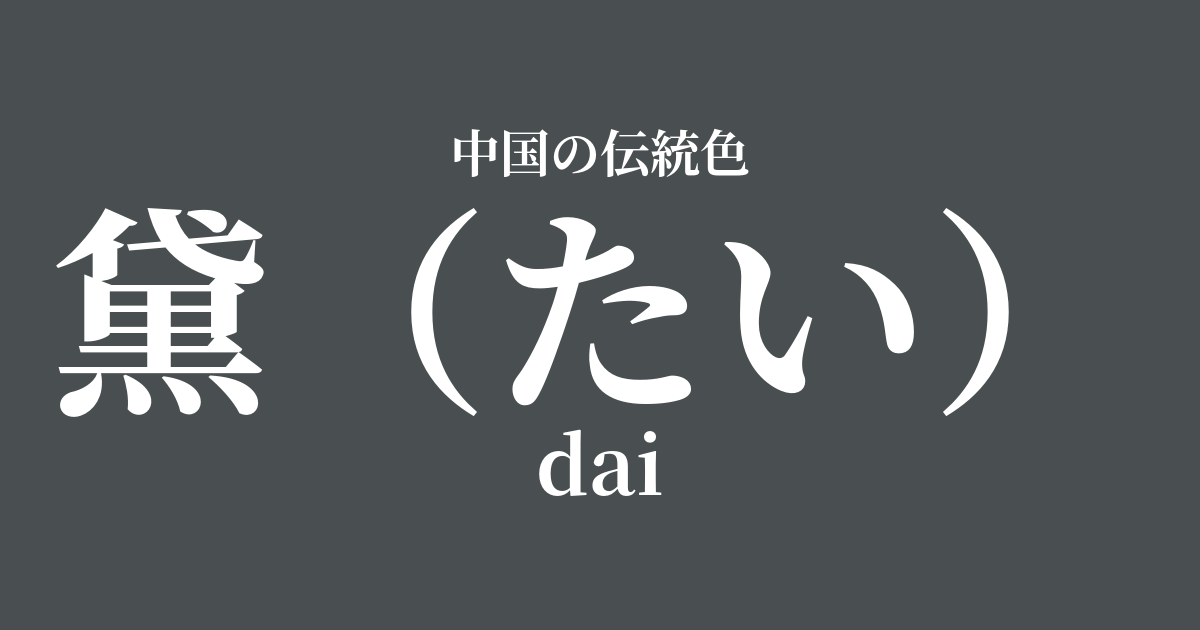
| Color name | 黛 |
|---|---|
| reading | sea bream |
| pinyin | dai |
| HEX | #494F50 |
| RGB | 73, 79, 80 |
What is Mayuzumi? Origin and etymology
Tai is a deep, almost black, bluish-green color derived from the color of "eyebrow ink" used by women to draw their eyebrows.
The origin of the word lies in the mineral "sekitai," which is the raw material. This is mainly made from stibnite (antimony sulfide), and it was powdered, dissolved in water, and used to draw eyebrows. The kanji character "黛" itself is a combination of "代" (dai, meaning substitute) and "黒" (kuro, meaning black), and originally referred to the act of drawing eyebrows or the tool itself.
This color can also be found in natural landscapes. The sight of distant mountains appearing bluish-black in the clear air after a rain shower is called "enzan" (distant mountains), and this beautiful scene has also been depicted in poetry and paintings as the color "mayuzumi."
Mayuzumi's historical background
The history of eyebrow makeup is long, with descriptions found in the "Chu Ci," a text from the Warring States period. It became truly popular during the Han dynasty, when court ladies competed to create beautiful eyebrows. In particular, the elegant "distant mountain eyebrows," said to have been favored by Zhuo Wenjun, the wife of the scholar Sima Xiangru, have been passed down through generations as the ideal eyebrow shape.
During the Tang Dynasty, eyebrow makeup entered its golden age. In a culture rich in international influences, women's aesthetic sensibilities became even more refined. There is an anecdote that Emperor Xuanzong had the "Ten Eyebrows" drawn for his palace ladies, depicting various eyebrow shapes, and it is said that noblewomen, including Yang Guifei, enjoyed changing the shape and thickness of their eyebrows from day to day.
Thus, Daizu was not merely a color name, but also symbolized the aesthetic sensibilities of ancient Chinese women and the splendor of court culture.
Dai in Chinese Art and Crafts
Dai-iro plays an important role in Chinese art, especially in landscape painting. Painters used this deep, bluish-black color to depict distant mountains shrouded in mist. Mountains depicted using this technique are called "Dai-iro" or "Shan-dai," and they bring depth and a sense of tranquility to the painting.
While dark brown (mayu-iro) doesn't often play a leading role in fashion culture, it's thought to have been used in the attire of intellectuals and bureaucrats as a subdued color similar to black or navy. When combined with more vibrant colors, it tightened the overall impression and conveyed an air of elegance and intelligence.
Furthermore, in the world of literature, the term "bitai" (眉黛) is used to describe a woman's beautiful eyebrows, and "hisomeru" (黛を颰める) describes a sorrowful expression. The term appears in numerous poems and prose as a symbolic word used to convey emotions and beauty.
A round of smiles, a smile, and a faceless Rokunomiya powder.
Color scheme preview
This is to check the readability of the text when this color is used as the background.
Mayuzumi's color scheme proposal
Ivory white (#FFF1E0)
The deep hues of the Mayuzumi color are enhanced by the soft, warm white of the Ivory White, creating a color scheme that evokes elegance and tranquility. It creates an atmosphere reminiscent of ink painting, expressing a dignified beauty.
Peony red (#EEA2A4)
The calm tones of the eyebrows, combined with the elegant red of the peony crimson, create an impression that balances feminine splendor with profound depth. It's a glamorous combination reminiscent of the attire of a noblewoman from the Tang Dynasty.
Stone green (#61B4AE)
The clear blue-green of Sekiryu complements the mountainous landscape aspect of Mayuzumi, evoking a sense of nature's grandeur and mystical atmosphere. This intelligent and calming color scheme is well-suited to expressing the worldview of landscape painting.
Practical Scenes
In interior design, incorporating dark brown as an accent wall in a study or bedroom adds depth and tranquility to the space. Combining it with ivory white or light wood-grain furniture creates a quiet and intellectual atmosphere.
In fashion, it's ideal for substantial items like coats, jackets, and suits. It gives a sophisticated, nuanced impression that's different from black. Adding accent colors like gold accessories or a peony-pink scarf will enhance its elegance.
In web and graphic design, using white or light gold as a background color can convey a sense of luxury and trustworthiness. Choosing white or light gold for text colors results in a highly readable, elegant, and sophisticated design.