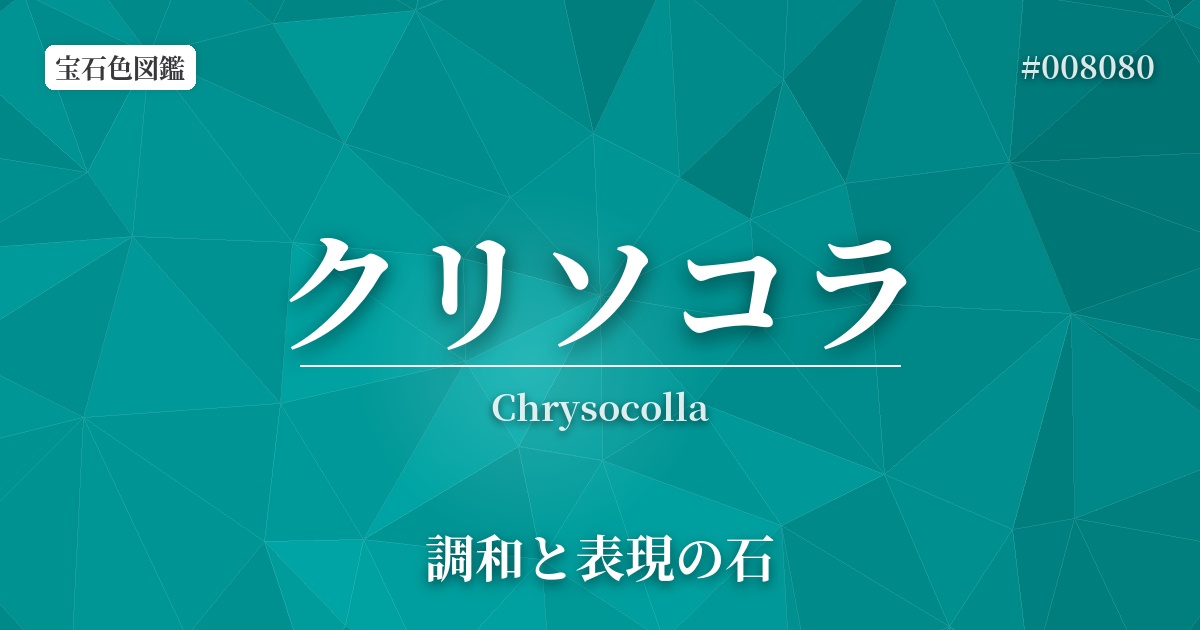
| English name | Chrysocolla |
|---|---|
| Katakana | Chrysocolla |
| HEX | #008080 |
| RGB | 0, 128, 128 |
| Mineralogy | Silicate minerals |
What is chrysocolla? Origin and mineralogy
The name chrysocolla comes from the Greek words "chrysos," meaning gold, and "kolla," meaning glue or adhesive. This is because in ancient Greece, this mineral was used as a type of flux (lathing) to join gold.
Mineralogically, it is a silicate mineral that is secondarily formed in the oxidation zone of copper deposits. It often occurs together with other copper minerals such as azurite, malachite, and turquoise, creating beautiful patterns when they are mixed together. Its color comes from the copper it contains, and it exhibits a wide range of colors from bright blue to green and blue-green.
Because it is very soft and brittle, with a Mohs hardness of 2.5 to 3.5, it is rarely processed into jewelry in its raw form. It is mostly sold on the market as "gem silica," which has been impregnated with quartz to increase its hardness, or mixed with other minerals.
Major producing regions include Arizona in the United States, Peru, Chile, the Democratic Republic of Congo, Russia, and Israel. Arizona, in particular, is famous for producing beautiful chrysocolla and gem silica.
Chrysocolla history and culture
Chrysocolla has a long history, and in ancient Egypt, it is said to have been a favorite stone of Cleopatra, the legendary beauty of ancient Egypt. It is said that she used the crushed powder of this stone as eyeshadow and wore it as jewelry, as a charm to prevent her from becoming emotional during negotiations and to encourage calm dialogue.
In ancient Greece and Rome, as its name suggests, it was practically used as a flux when processing gold products. Records also show that its beautiful blue-green color was utilized as a pigment for painting murals and other artwork.
Chrysocolla has also played an important role in Native American culture. Some tribes consider it a sacred stone that brings harmony to mind and body and enhances expressiveness, and it has been used in rituals and as an amulet.
Chrysocolla and color psychology
The blue and green hues of chrysocolla evoke the tranquility of the deep sea and the vibrant life force of a lush forest. These colors are believed to soothe the viewer's mind and calm emotional turmoil, relieving stress and anxiety. The majestic patterns, reminiscent of gazing upon the Earth, bring stability and peace to the heart.
Due to its appearance, it is also called the "Earth Stone," symbolizing a connection with Mother Earth and harmony with nature. It is believed to help balance things and build a stable foundation.
Chrysocolla is also known as the "stone of harmony and expression" and is believed to work on the throat chakra. It is said to support the enhancement of communication skills, allowing one to express one's thoughts and feelings calmly and accurately, and has been cherished by many people since ancient times.
Color scheme preview
This is to check the readability of the text when this color is used as the background.
Chrysocolla color scheme proposal
Sandy Brown (#F4A460)
The blue-green and sandy brown of chrysocolla create a natural and calming color scheme reminiscent of the earth and coastline. It provides warmth and a sense of security, creating a relaxed atmosphere and fashion style.
Gold (#FFD700)
The deep chrysocolla color, combined with the dazzling gold, creates a noble and exotic impression reminiscent of ancient Egyptian ornaments. It's recommended for creating a luxurious and sophisticated atmosphere.
Misty Rose (#FFE4E1)
The calming blue-green of chrysocolla, combined with a soft, hazy pink, creates a modern yet feminine impression. The beautiful contrast of colors adds a gentle touch to the sophisticated look.
Practical Scenes
In jewelry design, the unique, globe-like patterns of chrysocolla are best showcased when cut into a cabochon. Especially when used in large pendants or brooches, it exudes the presence of a true art piece. It pairs well with silver and complements both ethnic and modern designs.
Incorporating the color of chrysocolla into your interior design brings a sense of calm and depth to the space. Using it as an accent in wallpaper, cushions, or art panels creates an intellectual and relaxed atmosphere. Combining it with houseplants and wooden furniture results in an even more natural and comfortable space.
In fashion and web design, this color conveys a sense of trust and calmness. Using it as a key color on a website can provide users with a sense of security. In fashion, incorporating it into dresses, scarves, and other items allows for elegant and unique styling.