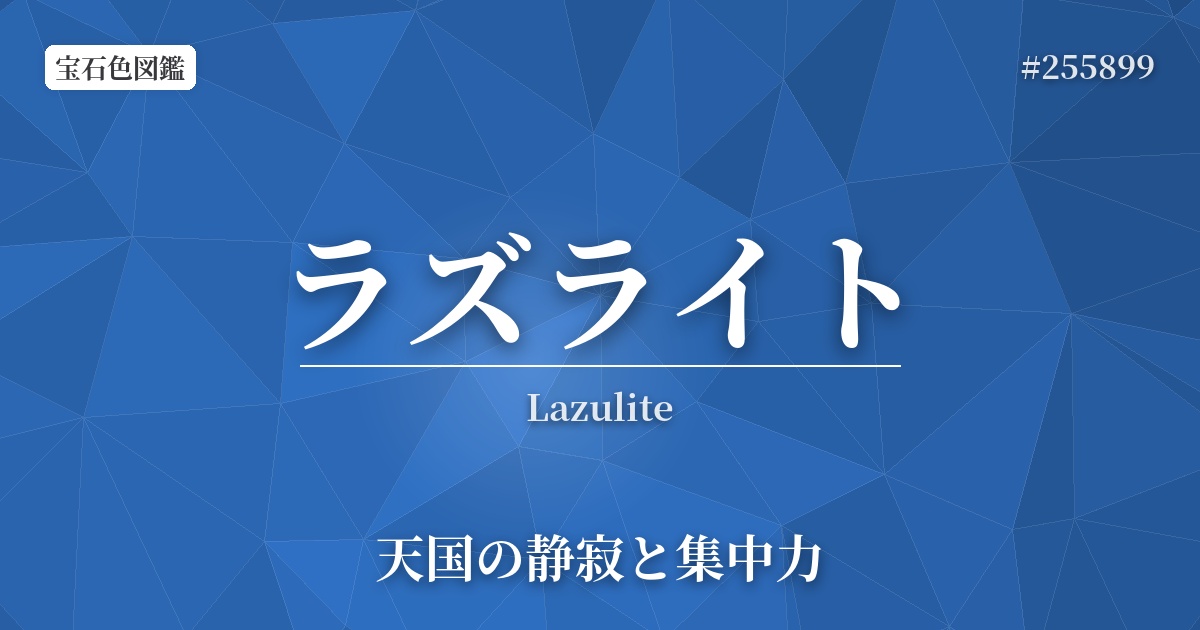
| English name | Lazulite |
|---|---|
| Katakana | Lazurite |
| HEX | #255899 |
| RGB | 37, 88, 153 |
| Mineralogy | Phosphate minerals |
What is lazurite? Origin and mineralogy
The name lazurite is said to originate from the German word "lazurstein," meaning "blue stone." Its etymology can be traced back to the Arabic word "lazaward," meaning "heaven" or "blue," suggesting that its color has long been associated with the heavens. Although its name is similar to lapis lazuli, it is completely different from a mineralogical perspective.
As a mineral, it is classified as a phosphate mineral containing magnesium, iron, and aluminum. Beautiful specimens are cut and used as gemstones, but large, high-quality pieces are extremely rare due to their limited supply and their tendency to cleave in specific directions.
The main sources are Brazil, Austria, Sweden, and the United States, but Canada's Yukon Territory is particularly known for producing some of the most beautiful lazurite crystals in the world.
The history and culture of lazurite
Lazurite was officially recognized as a mineral in 1795. It was first described by Martin Heinrich Klaproth, a prominent German chemist and mineralogist. Therefore, there are very few records of it being widely used in ancient civilizations.
Due to its similar name and color to lapis lazuli, it has historically been often confused with it. However, while lapis lazuli is a "rock" composed of multiple minerals, lazurite is a single "mineral," and its chemical composition and crystal structure are different.
While once a stone primarily prized among mineral collectors, in recent years its deep, sophisticated blue color has been recognized, and it has begun to attract attention in the jewelry world as a rare gemstone.
Lazurite and Color Psychology
Lazurite's deep, serene blue color is reminiscent of the night sky or the deep sea, and is said to have a calming effect on the viewer. It is also known as the "stone of concentration" because it dispels mental confusion and distractions, and clarifies thinking. It can bring calm judgment and thinking ability when you are faced with important decisions or when you want to immerse yourself in learning or research.
Lazurite, also known as the "stone of heaven," is a stone that symbolizes a connection to the spiritual realm. It is believed to help access higher consciousness and inner wisdom, and to enhance intuition. It is said that using it during meditation can lead you on a journey of deep self-discovery.
Color scheme preview
This is to check the readability of the text when this color is used as the background.
Lazurite color scheme suggestion
Silver (#C0C0C0)
The deep lazurite blue combined with silver creates a sophisticated impression reminiscent of stars shining in the night sky. It exudes a modern and intellectual atmosphere, making it perfect for jewelry and formal designs.
Sandy Brown (#F4A460)
The combination of deep blue and warm sandy tones creates a calm and natural harmony reminiscent of a coastal landscape. It's recommended for relaxed, earth-toned spaces and fashion.
Amethyst (#9966CC)
The blue of lazurite and the purple of amethyst are both colors with spiritual significance. When combined, they create a mysterious and noble atmosphere, giving the impression of stimulating creativity and intuition.
Practical Scenes
In the world of jewelry, lazurite holds a special place due to its rarity. Beautifully faceted stones, when set in platinum or silver settings, enhance their deep blue color, making them popular as sophisticated and elegant pendants and earrings.
In interior design, incorporating this color as an accent brings depth and tranquility to a space. Using it on one wall in a study, on cushions in the living room, or on artwork can create an intellectual and serendipitous atmosphere.
In websites and graphic design, lazurite blue is suitable for conveying reliability, expertise, and integrity. Using it as a corporate color or a key color for academic content instills a sense of security and intellectual sophistication in viewers.