
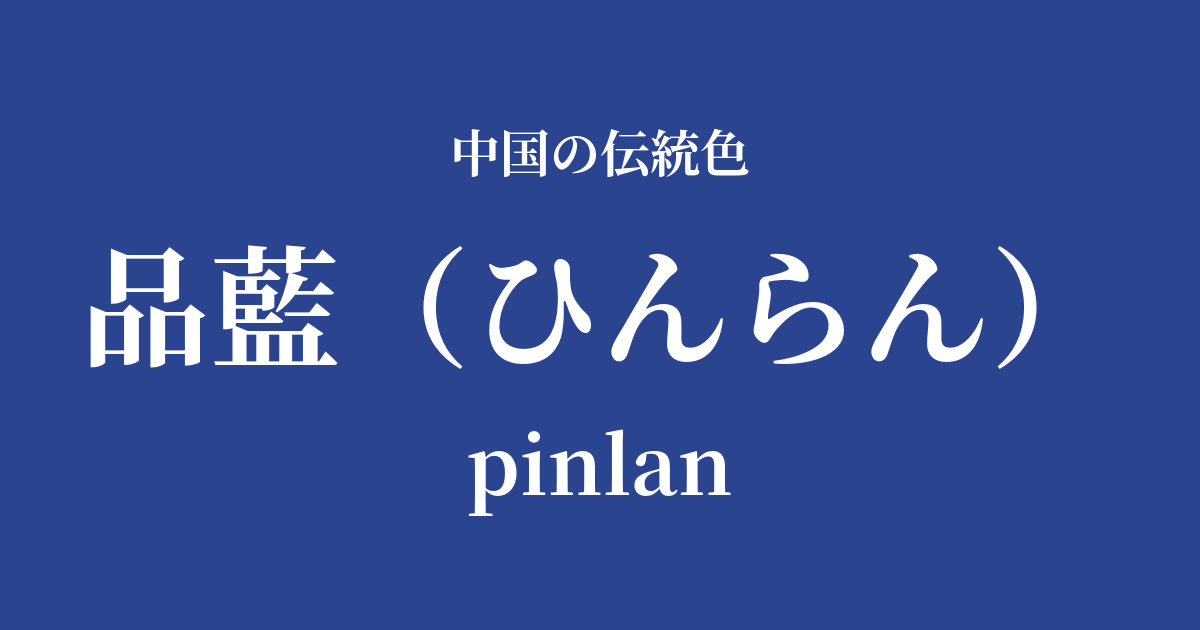
| Color name | Quality |
|---|---|
| reading | hinran |
| pinyin | bushlan |
| HEX | #2B4490 |
| RGB | 43, 68, 144 |
What is Pinlan? Origin and etymology
Hinran is a deep, slightly purplish, and dignified blue color. Its name succinctly tells the story of its origin.
The character "品" (hin) means "quality" or "grade." In ancient China, when it came to indigo dyeing, the deepest, richest, and highest-quality indigo color, which could only be achieved through repeated dyeing, was called "hinran" (hin-ran). More than just a name for a color, it was a testament to the pinnacle of the craftsman's skill and carried the connotation of a title bestowed upon the finest products.
Historical background of Pinlan
The history of indigo dyeing is very old, with records of it dating back to the Zhou dynasty. Over time, the technique became more refined, and particularly from the Ming dynasty to the Qing dynasty, indigo dye became a color of significant social importance.
During this period, indigo blue was designated as the base color for the "official robes" worn by government officials. Along with the "boshi" embroidery sewn onto the chest and back according to the rank of official, indigo blue clothing symbolized the status and authority of the person wearing it. In the solemn atmosphere of the Forbidden City, this deep blue appeared to people as the color of order and dignity.
High-quality silk fabrics dyed with indigo were highly valued not only in the royal court but also among wealthy merchants and literati in the private sector, and were used for clothing on special occasions and for luxurious furnishings.
Pinlan in Chinese art and crafts
The deep hues of indigo blue have imbued Chinese clothing culture and arts and crafts with a quiet dignity.
The most symbolic example is undoubtedly the official robes of the Ming and Qing dynasties. These robes, made of deep indigo silk and adorned with exquisite embroidery of birds and animals, represent one of the pinnacles of clothing culture at the time. Even in modern Hanfu, indigo is a color that conveys calmness and intelligence, and is favored for use in men's clothing and other garments.
Furthermore, the deep, vibrant blue of blue-and-white porcelain (sometsuke), exemplified by Jingdezhen, also resonates with the worldview of Pinlan. In particular, blue-and-white porcelain from the Yuan and early Ming dynasties, painted using imported pigments such as "smalt," exhibits such intense coloration, sometimes accompanied by black spots, that it evokes the depth of color found in Pinlan's work.
Blue, tori no indigo, and blue in blue.
Color scheme preview
This is to check the readability of the text when this color is used as the background.
Color scheme proposal for Pinlan
赭石 (#9C3823)
By combining the deep blue of Pinlan with the warm color of Ochre, the two colors complement each other, creating a powerful yet calm impression. This is a traditional color scheme that can also be seen in Chinese palace architecture and furnishings.
Tsukihaku (#EAF4FC)
The deep shade of indigo, combined with the pure white of moonlight, creates a serene and sophisticated atmosphere reminiscent of a clear night sky and moonlight. This combination is perfect when you want to give off an elegant and intellectual impression.
Yuhuang (#FFB61E)
By adding bright, vibrant orpiment as an accent to a noble indigo, this traditional color scheme gains a modern vibrancy and elegance. It's recommended for eye-catching and impressive designs.
Practical Scenes
The refined elegance and tranquility of indigo can be utilized in a variety of modern settings.
In fashion, incorporating this color into suits, coats, and dresses creates an outfit that conveys intelligence and sophistication. Lustrous materials like silk and velvet will further enhance the depth of the color. Using it as an accent color in accessories such as ties and scarves also creates a refined impression.
In interior design, using it as an accent wall in a study or bedroom can create a sense of depth and have a calming effect. Even incorporating it partially with cushions, curtains, or artwork can give the entire room a refined and sophisticated feel.
In the fields of web design and graphic design, it is suitable as a key color for corporate websites of companies that want to convey trustworthiness and expertise, or for brand websites that want to have a high-end feel. When used as a background color, it also has the effect of improving the visibility of text and images.