
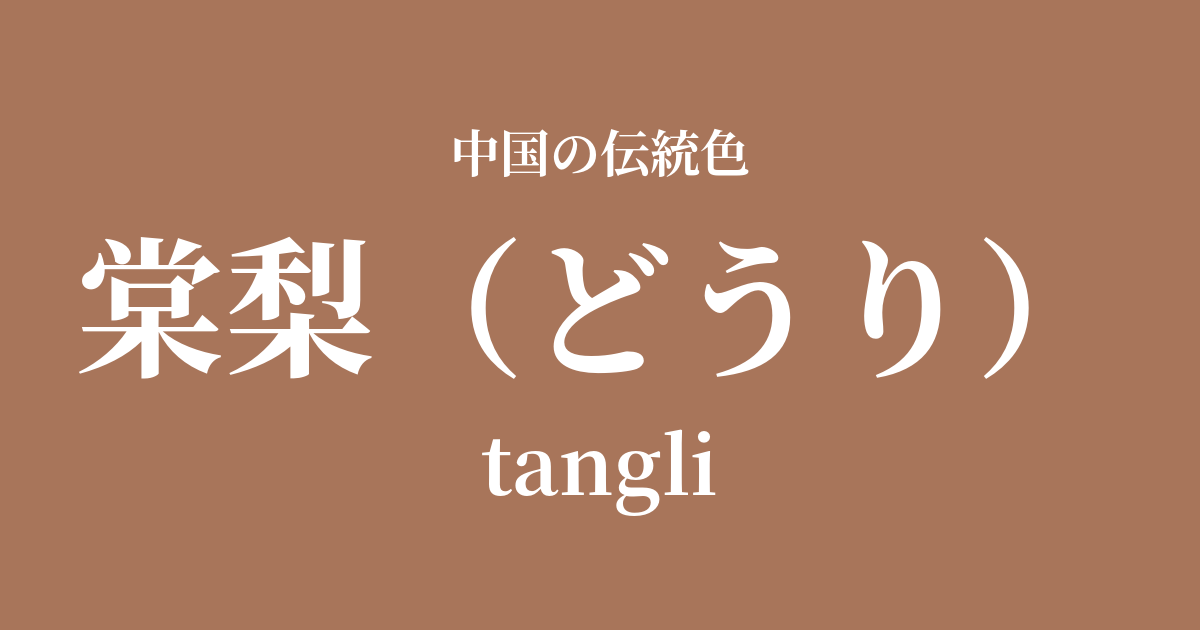
| Color name | Tanashi |
|---|---|
| reading | No way |
| pinyin | tangli |
| HEX | #A8755A |
| RGB | 168, 117, 90 |
What is a Tangli? Origin and etymology
Douri is a warm, reddish-brown color derived from the bark of wild pear trees and the color of their ripe fruit.
The character "棠" historically referred to garden pears or wild pears, while "梨" meant pears in general. The term "棠梨" in particular often refers to pear trees that grow wild in the mountains and fields untouched by human hands, conveying a sense of their simple yet powerful vitality.
The bark of the pagoda tree, which grows in harsh natural environments, takes on a unique, deep hue as proof of its endurance through wind and snow. This color name can be said to embody not so much splendor, but rather a gentle tranquility that accompanies everyday life and a sense of gratitude for nature's bounty.
Historical background of the pear tree
The prickly pear tree also appears as "sweet pear" in the "Book of Songs," the oldest collection of Chinese poetry. It is said that during the Zhou dynasty, a man named Shao Gong Shi, who was beloved by his people for his benevolent rule, judged lawsuits and rested under a sweet pear tree.
People sang in remembrance of Duke Shao, urging that the sweet pear tree he cherished not be cut down. From this story, the sweet pear tree (Tangli) came to be a symbol of benevolent rule and virtuous individuals, a story that has been passed down through generations.
It is unclear when the color name "Tōri" (棠梨) became established, but along with the story behind it, it is thought that people recognized it as a color with moral significance beyond just being a natural color.
Tangli in Chinese Art and Crafts
The simple and warm colors of the Tangli tree can be found in various Chinese art and crafts.
For example, in the world of ceramics, the natural brown color produced by iron-containing glazes is reminiscent of the color of the pear tree. This warmth of color is particularly evident in folk pottery used in the daily lives of ordinary people, in contrast to the magnificent porcelain intended for the royal court.
Furthermore, in traditional wooden architecture, the color of pagoda tree wood used for pillars and beams brings a sense of stability and tranquility to the space. In clothing culture, as one of the natural shades of brown obtained through plant dyeing, it was used in the clothing of ordinary people and was widely popular due to its durable nature and resistance to visible stains.
袾达棠、 無翦 Gard Gunder
Color scheme preview
This is to check the readability of the text when this color is used as the background.
Color scheme proposal for Tangli
Autumn color (#D9B612)
The combination of the calm brown of the pear blossom and the muted yellow of the autumn fragrance creates a warm and gentle impression reminiscent of the abundant harvest of autumn. It is a beautiful color scheme that harmonizes with other earth tones.
Moon white (#D6ECF0)
The warmth of the pear blossom and the refreshing, very pale blue of the moonflower complement each other perfectly. This combination creates a refined and elegant impression, reminiscent of a tranquil moonlit night.
Pilestone (#A55D4A)
By combining it with ochre, which has a stronger reddish hue than pear, depth and dimension are created within the same color family. The result is a unified color scheme that evokes a sense of earthiness and stability.
Practical Scenes
In interior design, the color of the pagoda tree brings warmth and tranquility to a space. Incorporating it into solid wood furniture and flooring, as well as linen and cotton fabrics, creates a natural and comfortable atmosphere. When used as an accent wall, it adds sophistication and a touch of luxury to the entire room.
In fashion, the color Tangli gives a classic and intellectual impression. It's the perfect color for timeless items like trench coats, leather jackets, and leather accessories. Paired with white or beige, it creates a gentle look, while pairing it with black or navy results in a modern and sophisticated style.
In web and graphic design, it is effective when you want to convey trustworthiness and stability. In particular, using it as a background or accent color on websites dealing with traditional crafts, organic products, or historical themes can deepen the worldview of the content.