
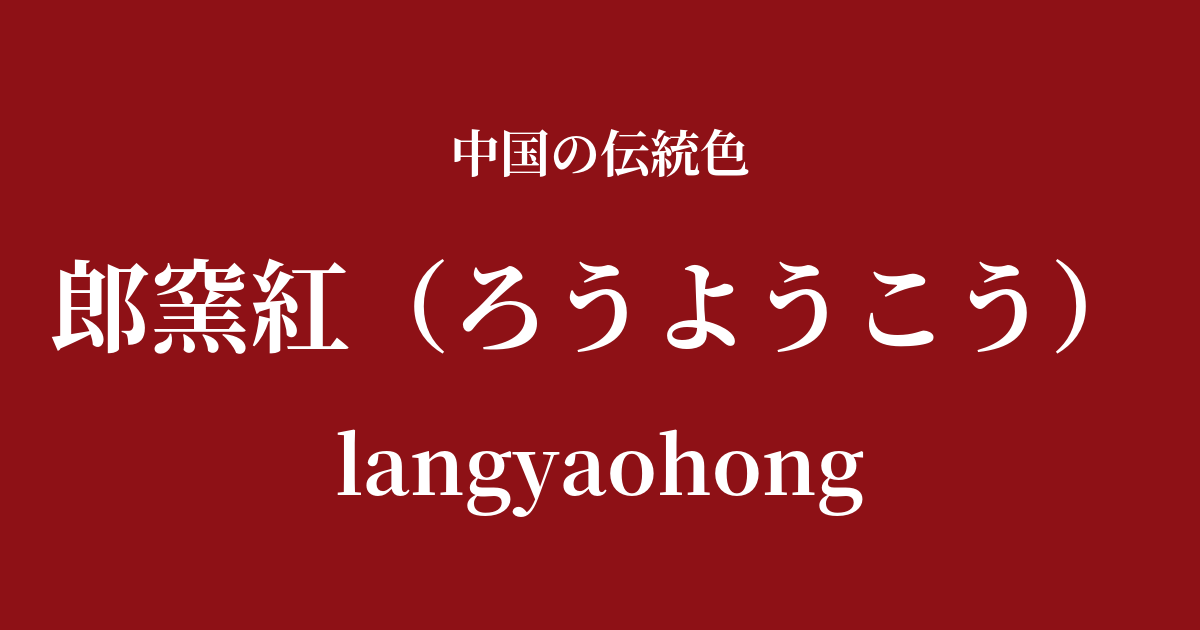
| Color name | Rokama Beni |
|---|---|
| reading | Rouyoukou |
| pinyin | langyaohong |
| HEX | #8E1116 |
| RGB | 142, 17, 22 |
What is Langyao Hong? Origin and Etymology
Langyao Hong is the color of a deep red glaze produced in Jingdezhen, Jiangxi Province, during the Kangxi era of the Qing Dynasty, using copper as a coloring agent. Its name originates from Lang Tingji, who was the governor of Jiangxi at the time and supervised the imperial kilns (official kilns) in Jingdezhen. It came to be called by this name because it was produced in the kilns he supervised, namely "Langyao."
This color was created with the aim of recreating the legendary red glaze known as "Saikou" or "Hosekikou," which was perfected during the Xuande era of the Ming Dynasty. Not only was the technique, which had once been lost, revived through tremendous effort, but it was also further refined, establishing a unique beauty with a glassy texture and strong luster.
Firing Langyao Red porcelain was extremely difficult. The copper red glaze will not develop its beautiful red color unless it is fired using a technique called "reduction firing," which involves precisely controlling the temperature and amount of oxygen inside the kiln. Even a slight deviation in the conditions will result in darkening or fading of the color. Therefore, the probability of producing a perfect Langyao Red porcelain is very low, and it is said that its production required enormous expense and effort, to the point that there is a saying, "If you want to be poor, fire Langyao Red."
Historical background of Langyao Hong
The Kangxi era (1662-1722) of the Qing Dynasty, when Langyao Hong was born, was a time known as the "Kangxi Prosperity Era," when a long period of warfare ended and society regained stability. The Kangxi Emperor, who deeply loved culture and art, revived the Jingdezhen Imperial Kiln, which had declined in the late Ming Dynasty, and devoted himself to porcelain production.
In 1705, when Lang Tingji was appointed Governor of Jiangxi and put in charge of supervising Jingdezhen, porcelain technology underwent a dramatic development. He diligently studied masterpieces from both ancient and modern times, and was particularly passionate about recreating the copper red glaze of the Xuande period of the Ming dynasty. Under his guidance, the craftsmen repeatedly experimented and finally perfected "Langyao Red," a vivid and lustrous red glaze that even surpassed the sacrificial red of the Xuande period.
Due to its rarity and beauty, Langyao Red porcelain was highly valued in the imperial court and used as a tribute to the emperor and as a gift during diplomatic occasions. Its high level of craftsmanship is considered one of the finest examples of Qing dynasty porcelain, and it had a significant influence on later ceramics.
Langyao Hong in Chinese Art and Crafts
The beauty of Langyao Red porcelain truly shines when applied to three-dimensional objects like porcelain. It is particularly evident in pieces such as vases, bowls, and cups.
Lang ware red porcelain has several points of interest for appreciating it. First, there is the phenomenon called "dakkou," where the glaze flows thinly around the rim of the vessel, making it appear white. Next, there is "suiyuu," where the glaze accumulates thickly near the bottom edge (footring), sometimes appearing glassy and greenish. And the way the glaze stops just at the edge of the footring is called "lang bu liu" (Lang does not flow), and was considered proof of perfect technique.
Furthermore, when Langyao Red pottery is held up to strong light, it appears a vivid red color, like living blood, hence it is also called "light and shadow." This enchanting beauty continues to fascinate many literati, emperors, and modern collectors.
Only one kiln is known as the only one, and the value of life is high.
Color scheme preview
This is to check the readability of the text when this color is used as the background.
Color scheme suggestion for rotan red
Gen (#191919)
The lustrous red of Langyao Red and the deep black of Xuan complement each other, creating a dignified and refined impression. It is ideal for creating a luxurious design or a traditional atmosphere.
Mud gold (#B79359)
The deep crimson of Langyao red, combined with the shimmer of gold, creates a magnificent and opulent atmosphere reminiscent of court culture. It is recommended for special occasions and for glamorous packaging designs.
Tsukihaku (#EAF4FC)
This combination is reminiscent of the white seen in the "removal of the mouth" technique of Langyao Red pottery. The pure white of the Moon White highlights the vibrancy of the Langyao Red, giving it a clean, sophisticated, and modern impression.
Practical Scenes
In interior design, Langyao Red adds a dramatic accent to any space. Even incorporating it into just a few items, such as cushions, curtains, or art panels, can elevate the entire room and create a sophisticated atmosphere. It pairs particularly well with dark brown wooden furniture and lacquered furnishings. Effective use of indirect lighting further enhances the depth and luster of the color.
In the world of fashion, this deep red symbolizes elegance and confidence. When used in dresses and blouses made of lustrous materials such as silk and velvet, the luster of Langyao Red is brought out to its fullest potential. Furthermore, even adding just one item in this color, such as a bag, shoes, or scarf, can add glamour and sophistication to an outfit.
In web and graphic design, using accent colors attracts the user's attention and creates a sense of luxury and trustworthiness. By combining them with achromatic colors such as white, black, and gold, or metallic colors, it is possible to create highly visible and impressive designs.