
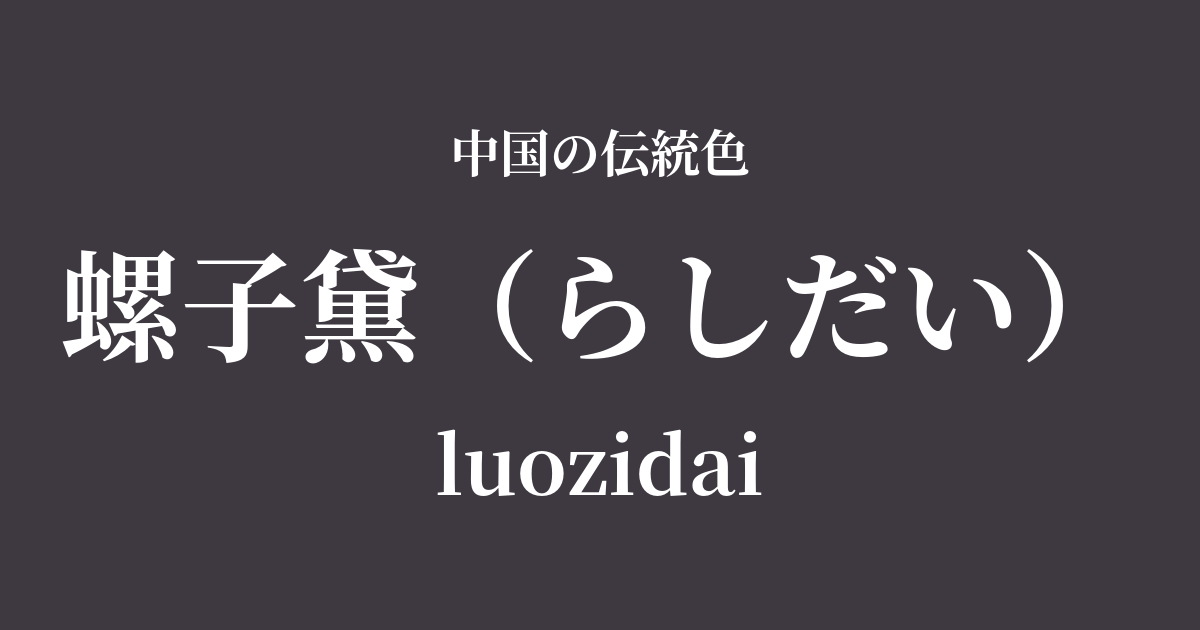
| Color name | Screwdriver |
|---|---|
| reading | It depends |
| pinyin | luozidai |
| HEX | #3E3841 |
| RGB | 62, 56, 65 |
What is Neji-Tai? Origin and Etymology
Rashidai is an extremely noble color name referring to a deep, slightly bluish black. Its name originates from the fact that this color was originally used as eyebrow pencil (mayuzumi).
"Neji" refers to a conch shell, and "Taizumi" refers to eyebrow ink itself. Therefore, the direct meaning of this term is eyebrow ink molded into the shape of a conch shell. At the time, this eyebrow ink was a very valuable import, brought to China from as far away as Persia (present-day Iran) via the Silk Road.
There are various theories about its ingredients, but it is said to have been made from powdered minerals such as lapis lazuli and azurite. Because it could be used to draw eyebrows without dissolving it in water, it was treated as a very convenient and expensive cosmetic.
Historical background of Nejidai
Luozidae (a type of eye makeup) was particularly popular during the Sui and Tang dynasties. It was especially popular among the empresses, concubines, and palace ladies in the court of Emperor Yang of Sui. There are even anecdotes that Emperor Yang would give away precious Luozidae to his palace ladies every day.
This trend continued into the Tang Dynasty, and it is said that Yang Guifei, known as a woman of unparalleled beauty, also favored the use of luozi brow makeup. Because it was an imported product, it was extremely expensive, and drawing eyebrows with luozi brow makeup was not merely a form of makeup, but also a symbol of wealth and high social status.
However, during the Song dynasty, cheaper and more readily available domestic eyebrow pencils began to spread. Consequently, the use of Luozidae gradually declined, and its name became a coveted color, preserved only in literature and history.
Luozhidai in Chinese Art and Crafts
The color of Luozidai eyebrow pigment can be seen in Tang Dynasty art, particularly in the beautiful portraits of court ladies known as "Shijozu" (court ladies' paintings). The eyebrows of court ladies depicted by painters such as Zhang Xuan and Zhou Fang are thick, clearly defined, and beautifully curved, suggesting the existence of high-quality eyebrow pigment like Luozidai.
Furthermore, in terms of clothing culture, the contrast between the vibrant and colorful Hanfu of the Tang Dynasty and the sharply defined eyebrows drawn with spiral eyebrow makeup created a refined beauty. The dark-colored eyebrows clearly defined the facial features and were an important accent that further enhanced the splendor of the clothing.
In the world of ceramics, the deep blue and black glazes found in Tang Dynasty sancai ware resonate with the mystical hues of luozhidai (a type of porcelain glaze). Through these works of art, one can sense the special aesthetic sensibility that people of that time held for these colors.
The screwdriver was born in the country, and the price was 100%.
Color scheme preview
This is to check the readability of the text when this color is used as the background.
Color scheme proposal by Neji Mayuzumi
Peony powder (#EEA2A4)
The deep, subdued hues of the rhino-dye and the soft, vibrant pink of the peony powder complement each other beautifully. This elegant and refined color scheme is reminiscent of the makeup and attire of noblewomen from the Tang Dynasty.
Moon White (#D9E9E5)
The deep, rich color of Neji-dai is complemented by the pure, pale blue-green of Tsukishiro, creating a calm and intellectual impression. This tranquil color scheme is suitable for designing studies and other quiet spaces.
Female yellow (#FF9900)
The cool tones of Nejidai and the vibrant, warm yellow of Jubilee create a striking contrast. This bold and sophisticated color scheme looks great in modern designs.
Practical Scenes
In interior design, incorporating Nejidai (a type of wood grain) into accent walls, cushions, or artwork brings depth and a refined atmosphere to a space. Combining it with light white, silver, or pale wood grain creates a tranquil and modern ambiance. It's particularly well-suited for places where you want to relax, such as a study or bedroom.
In fashion, using this color in coats, dresses, or high-quality leather goods creates a chic and sophisticated impression. In particular, incorporating it into makeup as eyeliner or eyeshadow can dramatically define the eyes and add a mysterious allure.
In web and graphic design, using gold or silver as a background color makes the text and images placed on top stand out, conveying a sense of luxury and professionalism. Combining it with gold or silver creates a sophisticated design suitable for luxury brand websites.