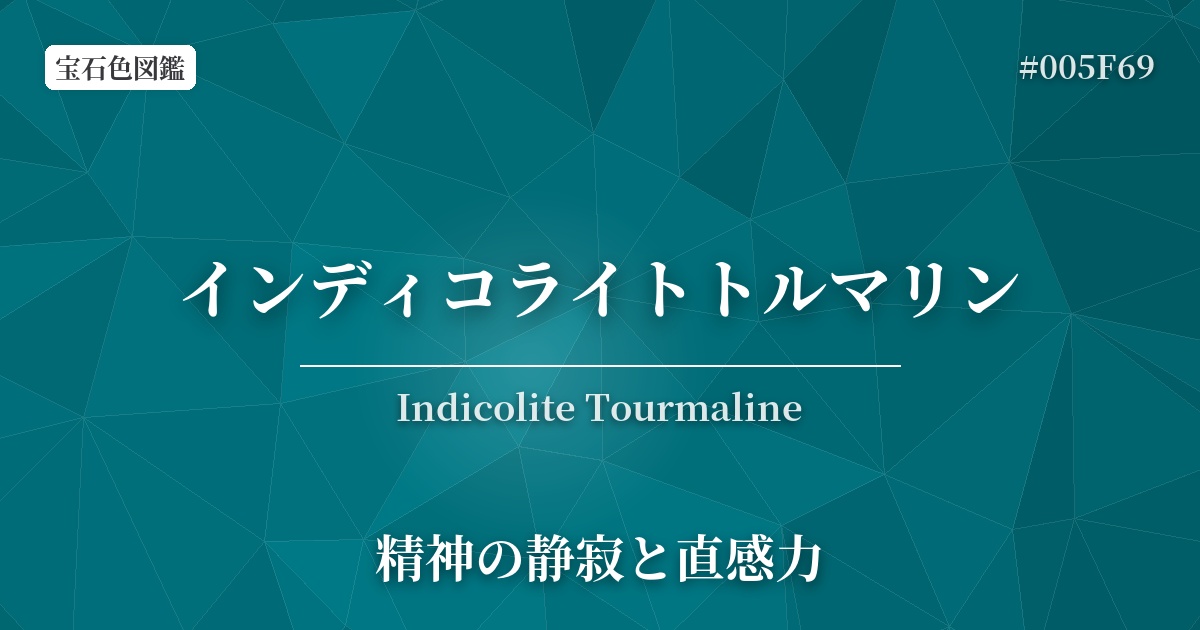
| English name | Indicolite Tourmaline |
|---|---|
| Katakana | Indicolite Tourmaline |
| HEX | #005F69 |
| RGB | 0, 95, 105 |
| Mineralogy | Silicate minerals |
What is indicolite tourmaline? Origin and mineralogy
The name indicolite tourmaline comes from its deep, beautiful indigo color. "Indicolite" is a common name for the gemstone, while mineralogically it is a type of tourmaline. The name tourmaline itself comes from the Sinhalese word "trumali," meaning "stone of various colors," and as the name suggests, it is known for its wide range of colors.
As a mineral, indicolite belongs to the group of silicate minerals with complex compositions. The beautiful blue to blue-green color of indicolite is mainly due to the iron (Fe2+) it contains. Depending on the amount of iron and the balance with other elements, a variety of shades are produced, from pure indigo to greenish teal blue.
The main producing regions include Brazil, Afghanistan, Pakistan, Namibia, and Nigeria. Brazilian varieties, in particular, are famous for their high quality, but the color tendencies vary subtly depending on the region, and each variety possesses its own unique beauty.
The history and culture of indicolite tourmaline
Due to its wide range of colors, tourmaline has often been confused with other gemstones throughout history. For example, a large gemstone known as "Caesar's Ruby," once owned by the Russian imperial family, was later identified through analysis as red tourmaline (rubellite). Similarly, indicolite may have also been mistaken for blue sapphire in the past.
In the early 18th century, Dutch merchants brought tourmaline from Sri Lanka to Europe. They noticed that when the stone was heated, it attracted ash and dust, and they called it "Aschentrecker" (ash attracter). This is a physical property of tourmaline called pyroelectricity, and it is one of the characteristics that has been known since ancient times.
It was only in the modern era, with the advancement of gemology, that indicolite was clearly distinguished by its name and its intellectual beauty came to be widely appreciated. Today, its unique color and rarity make it beloved by jewelry designers and collectors worldwide.
Indicolite tourmaline and color psychology
The deep, serene blue-green color of indicolite tourmaline is said to evoke images of vast oceans and nighttime forests, and has a calming effect on the viewer. This color symbolizes intelligence, composure, and introspection, and may help soothe mental turmoil and enhance concentration.
As a power stone, indicolite is considered a stone of "mental tranquility and intuition." It is believed to activate the throat chakra, which governs communication, and the third eye chakra, which governs intuition and insight. This is said to support listening to one's inner voice and clearly expressing thoughts and feelings.
It is also said to bestow the ability to discern the truth and encourage honest self-expression. When faced with complex problems or situations requiring calm judgment, the serenity and clarity brought by this gemstone color may guide you on the right path.
Color scheme preview
This is to check the readability of the text when this color is used as the background.
Color scheme proposals for indicolite tourmaline
Antique White (#FAEBD7)
The deep blue-green of Indicolite, combined with warm antique white, creates a sophisticated yet gentle color scheme. It's recommended for intelligent and calming spaces and designs.
Burnt Sienna (#E97451)
Burnt Sienna, with its deep blue-green and earthy reddish-brown hues, is almost a complementary color, enhancing each other's beauty. It's ideal for expressing both the power and tranquility of nature simultaneously.
Champagne (#F7E7CE)
The delicate, elegant hue of champagne adds a touch of glamour to the sophisticated atmosphere of Indicolite. This combination is luxurious yet not overly flashy, creating an elegant and special impression.
Practical Scenes
In jewelry design, indicolite tourmaline, with its sophisticated hue, often takes center stage in various items such as rings, pendants, and earrings. Its cool beauty is particularly enhanced when combined with platinum or white gold, creating a refined impression. It is also suitable for men's cufflinks and tie pins.
In interior design, incorporating this color as an accent wall in a study or bedroom can create a calming and focused atmosphere. Additionally, using this color in cushions, rugs, or artwork can bring depth and sophistication to a living room.
In website and graphic design, it's ideal for brands that want to convey trustworthiness, expertise, and stability. When used as a key color or button color on websites of financial institutions, law firms, and technology companies, it can give users a sense of security and an impression of intelligence.