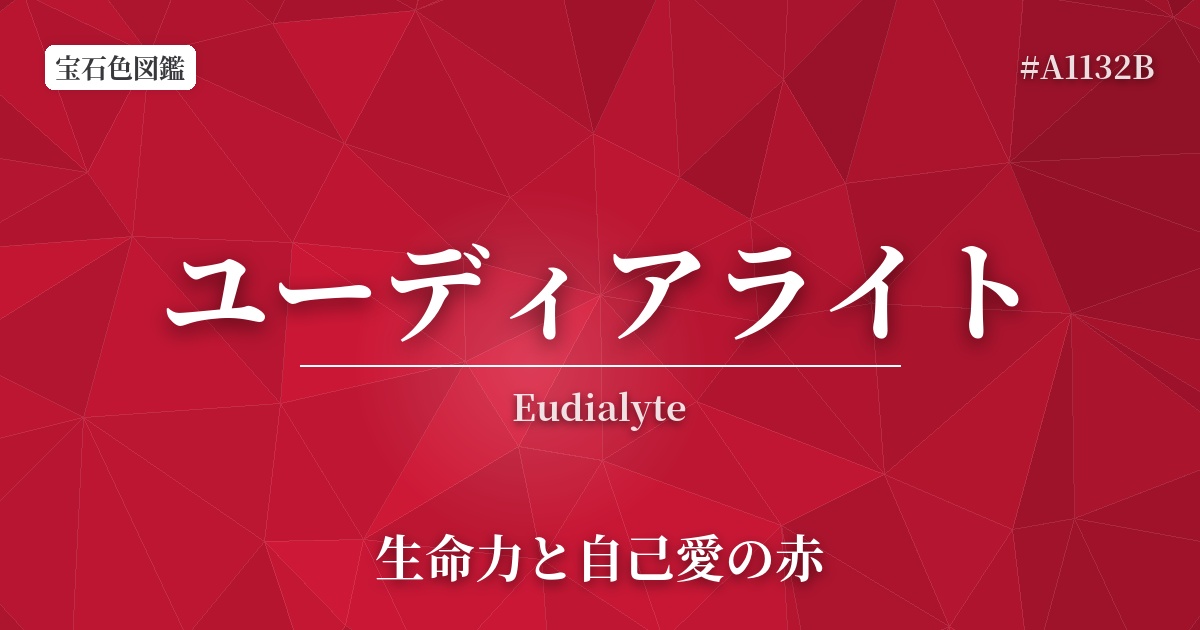
| English name | Eudialyte |
|---|---|
| Katakana | Eudialight |
| HEX | #A1132B |
| RGB | 161, 19, 43 |
| Mineralogy | Silicate minerals |
What is Eudialyte? Origin and Mineralogy
The name eudialyte comes from the Greek words "eu" (well) and "dialytos" (to dissolve). This name was given because of the mineral's chemical property of being easily soluble in acid.
As a mineral, it is a silicate mineral with a complex composition containing sodium, calcium, cerium, iron, manganese, zirconium, and other elements. Its main source is the Kola Peninsula in northwestern Russia, known for producing high-quality crystals. It can also be found in Greenland, Norway, Canada, and other locations.
Its colors range widely from vibrant magenta red to pink, reddish-brown, purple, and yellow, and it often contains inclusions of minerals such as aegirine (black) and nepheline (white). The unique patterns created by these inclusions are what make eudialyte so appealing, as no two pieces are exactly alike. It is a relatively soft mineral with a Mohs hardness of 5 to 5.5.
The key words for this gemstone are "the red of vitality and self-love." Its deep, pulsating red color is said to give the wearer vitality and positive energy, and teach the importance of loving and accepting oneself.
History and Culture of Eudialyte
Eudialyte was officially described as a mineral in 1819. It was first discovered in Greenland, so its history as a gemstone is relatively short. Therefore, there are no records of it being found in the ruins of ancient civilizations or used in the jewelry of medieval royalty and nobility.
However, among the Sami people, the indigenous inhabitants of the Kola Peninsula, where the stone is primarily produced, it is said to be called "Sami blood" and has been associated with legends. There is a story that the blood of a hero who fought for the land turned into stone, and it has been cherished as a protective amulet.
In modern times, its unique beauty has made it highly popular as a collector's stone. Furthermore, its distinctive patterns are increasingly being utilized in cabochon cuts, resulting in unique jewelry such as pendants and brooches.
Eudialytes and Color Psychology
Eudialyte's deep, passionate red color symbolizes vitality, energy, and drive in color psychology. It is said to increase the viewer's heart rate and boost energy levels, promoting mental and physical revitalization. This color will give you the courage to push forward towards your goals and the strength to face challenges.
Furthermore, the pink and purple hues mixed with red symbolize themes such as self-love, healing, and spiritual growth. It reminds us of the importance of cherishing and accepting ourselves first, as well as loving others. In the world of gemstones, it is highly valued as a stone that helps free the mind from negative emotions and past traumas, and enhances self-esteem.
Color scheme preview
This is to check the readability of the text when this color is used as the background.
Eudialight's color scheme proposal
Slate Gray (#708090)
The combination of deep red and cool slate gray highlights the vibrancy of Eudialyte, creating a modern and sophisticated impression. It's recommended for creating an urban and stylish atmosphere.
Moss Green (#8A9A5B)
Red and green are almost complementary colors, but by combining them with a muted green like moss green, they accentuate each other's colors while creating a natural and calming harmony reminiscent of forests and the earth.
Antique White (#FAEBD7)
The warm antique white gently complements the passionate red of Eudialyte, creating an elegant and classic atmosphere. The color scheme is both elegant and approachable.
Practical Scenes
In the world of jewelry design, eudialyte is generally used in pendant tops, brooches, and earrings rather than rings, due to its low hardness, as these pieces are more susceptible to impact. Large cabochon cuts, in particular, that make the most of the unique patterns created by the black and white minerals, are gaining popularity.
In interior design, incorporating this deep red color as an accent in cushions, art panels, rugs, etc., can infuse a space with warmth and vibrant energy. It is especially well-suited to modern spaces with grayish tones and interiors based on natural wood grain.
In website and graphic design, this color is effective as a key color for brands that want to convey concepts such as passion, innovation, and energy. When combined with dark background colors, it can create a sense of luxury and expertise, resulting in a powerful design that attracts attention.