
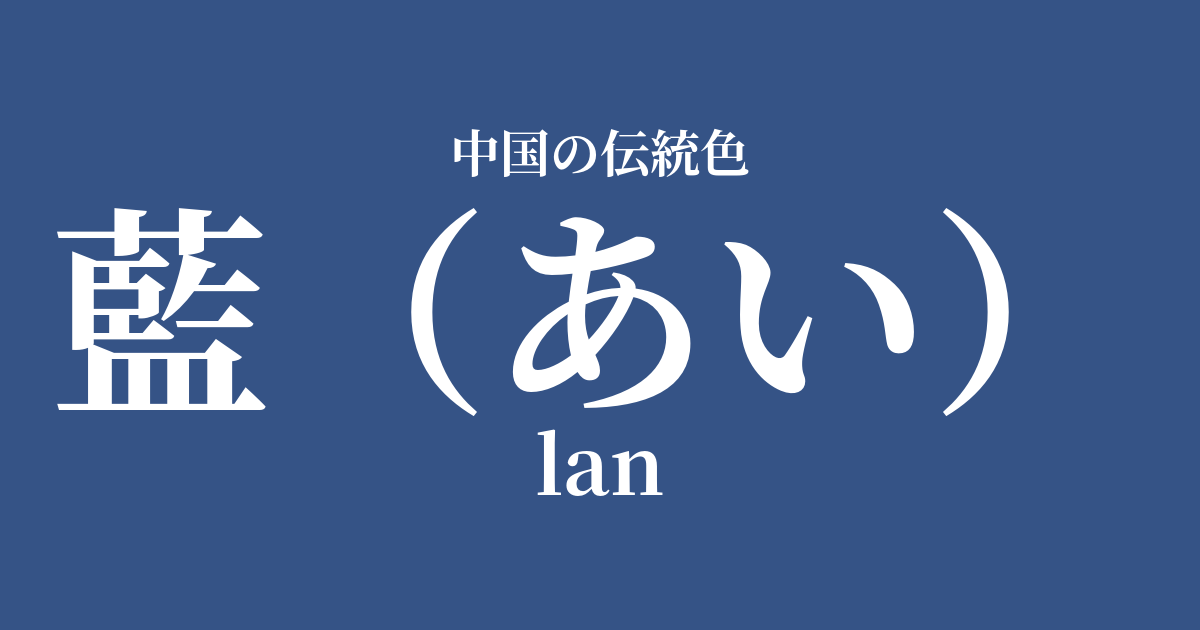
| Color name | 藍 |
|---|---|
| reading | love |
| pinyin | lan |
| HEX | #355386 |
| RGB | 53, 83, 134 |
What is "Aran"? Origin and etymology
The word "Ai" (蓝) originally referred to the indigo plant itself, which has been used as a dye since ancient times. The dye made by fermenting the leaves of this plant produces a deep, calming blue color, and it eventually became established as the name of that color.
The kanji character "蓝" is a phono-semantic character formed by combining "艹" (grass radical), which represents a plant, and "監" (supervisor), which represents a sound. "監" means to see something reflected in a water basin, which evokes the image of dipping dye into water to check its color.
In ancient China, a wide range of colors, including green and even shades close to black, were called "blue," but "lan" (蓝) developed into a special word specifically referring to the unique, deep blue color obtained through indigo dyeing.
The historical background of blue
The history of indigo dyeing is very old; the "Book of Songs," a text from the Zhou Dynasty (circa 1046 BC – 256 BC), contains a poem describing women picking indigo, suggesting that it was already deeply rooted in people's lives at that time.
During the Qin and Han dynasties, indigo dye became widely used as a color for common people's clothing due to its low cost and durability. While its vibrant colors were favored by the aristocracy, this practical blue was one of the most familiar colors that colored people's daily lives.
During the Tang Dynasty, dyeing techniques further developed, resulting in a wider range of blues, but "blue" (蓝) retained its character as a simple yet powerful color for the common people. Then, during the Ming and Qing Dynasties, indigo dyeing techniques reached their peak, and distinctive and beautiful indigo-dyed textiles were produced in various regions. In particular, the stencil-dyed cloth called "Lan Yin Hua Bu" produced in the Jiangnan region is known for its exquisite patterns and deep colors.
Blue in Chinese Art and Crafts
The beauty of "blue" is best exemplified by the porcelain known as "Qinghua," which flourished during the Yuan, Ming, and Qing dynasties. The patterns drawn with cobalt pigment on the white porcelain surface develop into a vivid blue color when fired. Its refined beauty captivated everyone from the royal court to the common people, and even the royalty and nobility of distant Europe.
In the context of clothing culture, indigo-dyed cotton clothing was called "fui" and was considered a symbol of commoners and scholars who did not hold official positions. This color embodied an honest and simple aesthetic that did not seek ostentation. On the other hand, Hanfu (Chinese traditional clothing) made of high-quality silk dyed in deep indigo exuded a calm dignity and was favored by intellectuals.
Furthermore, in "blue-green landscapes," a genre of Chinese painting, utopian landscapes are vividly depicted using mineral pigments. The blue used there is "stone blue," and the gentle, deep hue of "blue" derived from natural plants can be said to be at the root of the Chinese aesthetic sense associated with the color blue.
Blue, tori no indigo, and blue in blue.
Color scheme preview
This is to check the readability of the text when this color is used as the background.
Blue color scheme suggestion
Moon white (#D9D6C3)
The combination of deep indigo and pale yellowish-white, reminiscent of moonlight, evokes a quiet night sky and the moon. It creates a calm and dignified, traditional yet refined and serene atmosphere.
Pilestone (#995A36)
The indigo blue and ochre reddish-brown colors are a natural color scheme that evokes images of plants and the earth. They bring warmth and stability, making them suitable for creating simple, comforting spaces and designs.
Yuhuang (#FFB61E)
The contrast between deep blue and vibrant yellow powerfully highlights each other, creating a magnificent impression. This noble and striking color scheme is also found in the architecture and decorations of Chinese imperial courts.
Practical Scenes
In interior design, incorporating "blue" into accent walls, sofas, rugs, etc., adds depth and tranquility to a space. When combined with off-white, light gray, and warm wood tones, it creates a quiet and sophisticated Chinoiserie or Japanese modern style.
In fashion, indigo-dyed dresses and sets give an intelligent and sincere impression, making them suitable for business settings. Indigo-dyed clothing, the root of denim, adds a natural depth to casual wear. Paired with white, it creates a fresh look, while paired with beige, it gives an elegant impression.
In websites and graphic design, using white as the main color conveys a sense of trust and expertise to the viewer. Using white or moon white for text improves readability, while adding a small amount of a vibrant color like orpiment as an accent attracts attention and tightens the overall design.